Home / Dragon / Dragon Soul Fragments/Crystals
How to Obtain Dragon Soul Crystals in Infinity Kingdom
2022-01-22
Dragons are among the most important sources of account power in Infinity Kingdom. Dragon Crystals are used to improve their skills, develop their Talent Trees and raise their Portrait levels, so even established…
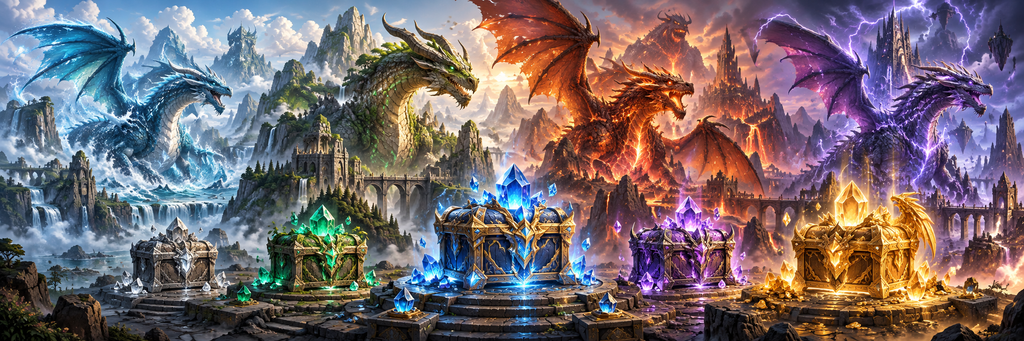
Dragons are among the most important sources of account power in Infinity Kingdom. Dragon Crystals are used to improve their skills, develop their Talent Trees and raise their Portrait levels, so even established players continue needing enormous quantities of them.
The difficulty is that not every dragon is developed through the same sources. Water, Earth, Fire and Lightning Crystals can be farmed from Gnome Bosses, while Wind, Holy and Shadow Crystals depend much more heavily on specialised shops, seasonal currencies and limited events. Knowing where each type comes from helps you plan several seasons ahead and prevents scarce currencies from being spent on poor-value alternatives.
This guide covers the main ways to obtain Dragon Crystals, how Gnome Boss rewards scale and how your available boss levels improve as your server progresses through the seasons.
Elemental Dragon Crystals and Gnome Bosses
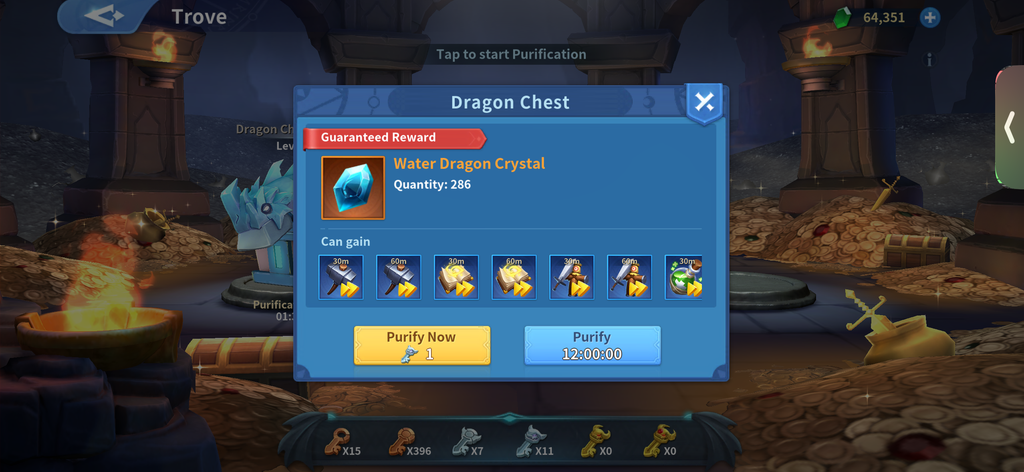
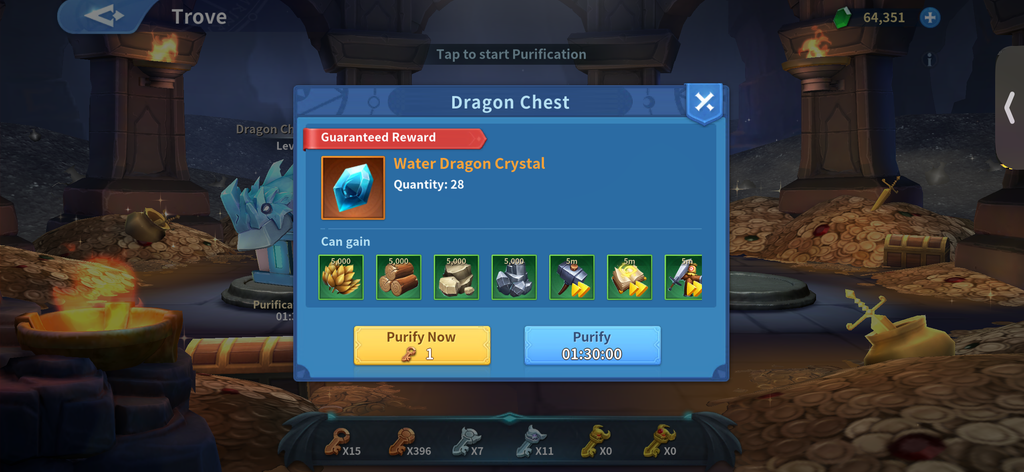
Water, Earth, Fire and Lightning each have a corresponding Gnome Boss. Defeating one awards a Dragon Chest containing crystals for that boss’s element, making regular boss farming the main repeatable source of crystals for these four dragons.

Wind is also an elemental dragon, but it does not have a corresponding Gnome Boss and must be developed through other sources.
Dragon Chests are divided into five qualities:
- Common: Grey
- Uncommon: Green
- Rare: Blue
- Epic: Purple
- Legendary: Gold
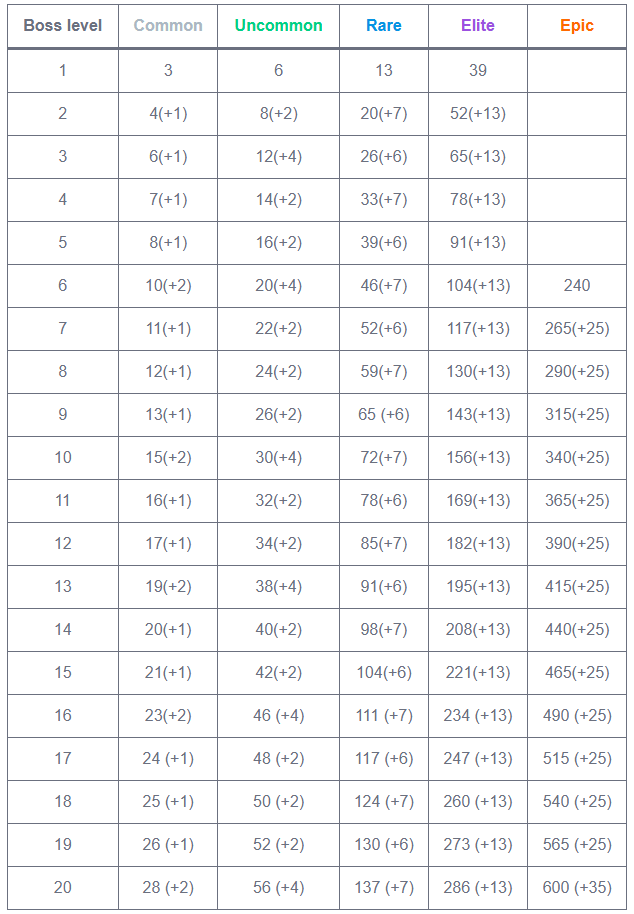
Both the boss level and the chest quality matter. A higher-level boss increases the guaranteed number of crystals contained within a chest of the same quality, while moving from a Common chest to a Rare, Epic or Legendary chest produces a much larger increase.
How Boss Levels Increase with Seasons
New servers do not immediately have access to all 20 Gnome Boss levels. The available level cap increases as the server advances through its seasonal progression.
The difference between individual levels remains fairly modest, however. Comparing Level 18 and Level 20 chests of the same rarity, Level 20 contains approximately 10–12% more Dragon Crystals:
Defeating a boss places its Dragon Chest in the Trove, where it can be purified over time. Because the Trove has limited space, active boss farming also requires you to manage purification timers and Dragon Chest Keys.

Keys allow a matching chest to be opened immediately. Lower-rarity keys can now be combined into higher-rarity keys, which makes unwanted Common and Uncommon keys more useful than they were under the original system. Even so, higher-quality keys remain valuable, and it is sensible to reserve them for moments when your Trove is full or when an Epic or Legendary chest would otherwise prevent you from continuing to farm.
Wind Dragon Soul Crystals
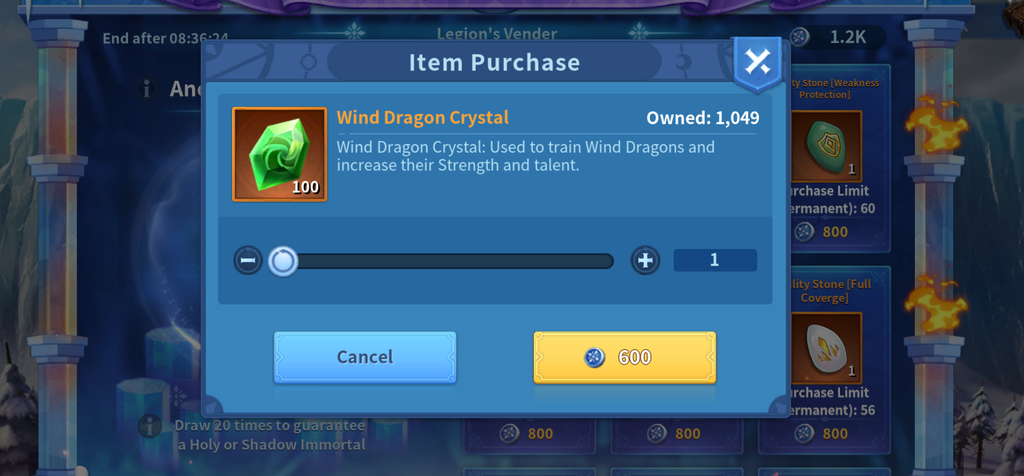
Unlike Water, Earth, Fire and Lightning, the Wind Dragon has no dedicated Gnome Boss. Wind Dragon Crystals must instead be obtained through specialised shops and rewards.
The two most important recurring sources are:
- Arena Insignia Shop, using Arena Insignias
- Legion’s Vender, using Cold Silver earned from Legion of Frostborne
The addition of Wind Dragon Crystals to Legion’s Vender means that the Arena is no longer their exclusive source. However, both currencies have important competing uses. Arena Insignias are accumulated gradually, while Cold Silver is needed for exclusive KvK Ability Stones and can also be converted indirectly into Cinder Shop progress by buying and recycling unwanted stones.
For most developing accounts, important KvK and Cinder Shop skills should therefore be completed before Cold Silver is redirected into Wind Dragon Crystals. Once the necessary skills are covered, Legion’s Vender becomes one of the best opportunities to make meaningful Wind Dragon progress each season.
Holy and Shadow Dragon Soul Crystals
Holy and Shadow Dragon Crystals remain considerably harder to obtain than the standard boss-farmed crystals. Their availability is spread across premium shops, rotating rewards and limited events rather than a permanent Gnome Boss.
Current sources include:
- VIP Shop
- Rune Factory Shop
- Selected GTarcade monthly rewards
- Limited-time events and promotional bundles
- Theia’s Roulette, following their addition in Update 2.9.8
Theia’s Roulette is now particularly important because it gives players another recurring opportunity to collect meaningful quantities of Holy and Shadow Crystals. Availability still depends on the active Roulette rewards, so players should inspect each event before committing Gems or paid spins.
The VIP and Rune Factory Shops also provide both crystal types, but neither purchase exists in isolation. VIP Points and Rune Factory currency can be used on other scarce progression items, including Immortal fragments and artifact-related materials. Buying Dragon Crystals is therefore worthwhile when you are actively developing that dragon, but much less attractive when the crystals will simply sit unused.
For most accounts, Holy and Shadow Dragons should be treated as long-term projects rather than something that can be completed through ordinary daily farming.ogression is intentionally slow and should be viewed as a long-term investment.
Choosing Between Holy and Shadow
If your resources only allow you to develop one premium dragon, the decision should begin with the march you actually intend to use.
The Holy Dragon remains the more generally applicable option. It fits into a broad range of PvE and PvP formations and is normally the safer investment when you are uncertain about your long-term build.
The Shadow Dragon is more specialised, but its Decay mechanics and PvP utility can be extremely valuable in the right formation. Players building specifically around those interactions may gain more from Shadow than from a general-purpose Holy Dragon.
Neither dragon is automatically correct for every account. Because their crystals are so scarce, changing direction after investing heavily is expensive. Decide on the march first, then begin purchasing crystals.
Spending Dragon Crystals Efficiently
Focusing on one dragon remains good advice, but the old fixed priority of Skills, then the entire Talent Tree, then Portraits is too simplistic.
Dragon Skills should be raised first, particularly until the requirements for the Talent Tree are met. Once Talents become available, both the Talent Tree and Dragon Portrait compete for the same elemental Dragon Crystals. Talents also require Dragon Essence.
Early Portrait levels are comparatively cheap and provide efficient raw attributes to the entire march. Talent nodes become especially valuable when they unlock percentage bonuses, important special nodes or the dragon specialisation you intend to use. The most efficient path therefore moves between Portrait and Talent investment rather than completing one entire system before touching the other.
A sensible general approach is:
- Develop the dragon’s main skills and meet the Talent Tree requirements.
- Take the inexpensive early Portrait levels.
- Progress toward the important Talent nodes and chosen specialisations.
- Compare the next Portrait level with the next useful Talent upgrade.
- Continue alternating until the important Talent branches and efficient Portrait levels are completed.
The exact stopping points depend on your dragon, build and available Dragon Essence. What matters is avoiding large investments in expensive minor nodes while cheaper Portrait attributes remain available, or pushing Portraits indefinitely while ignoring powerful percentage-based Talent bonuses.
Common Mistakes
The most common Dragon Crystal mistakes are:
Treating Portraits and Talents as a rigid one-before-the-other progression instead of comparing their current value.
- Assuming all five elemental dragons can be farmed from Gnome Bosses.
- Farming Level 20 bosses inefficiently when Level 18 can be cleared far more consistently.
- Farming lower bosses despite being able to defeat Level 20 comfortably.
- Allowing the Trove to remain full and losing opportunities to collect more chests.
- Using valuable high-rarity keys without considering purification time and future farming.
- Spending Arena Insignias on minor rewards while actively developing the Wind Dragon.
- Buying Wind Crystals with Cold Silver before obtaining important KvK and Cinder Shop skills.
- Buying Holy or Shadow Crystals without having a clear march planned for that dragon.
- Splitting crystals between several unfinished dragons.
Conclusion
Dragon Crystal farming improves naturally as your server advances. Higher levels always improve the contents of an equivalent chest, but the increase between individual boss levels is modest enough that reliable clears still matter.
Water, Earth, Fire and Lightning can be developed steadily through boss farming, while Wind, Holy and Shadow require much more deliberate currency planning. Wind players should combine Arena progression with Legion’s Vender purchases once their essential skills are secured, while Holy and Shadow players should take advantage of suitable Theia’s Roulette rotations and carefully selected shop purchases.
Above all, develop dragons with a purpose. Choose the march first, concentrate your crystals and compare the value of Skills, Talents and Portraits at each stage instead of spreading resources across every dragon at once.