
Home / Builds (all elements) / Conquest Season Builds
Water Merlin Regen with Dual Tank Bjorn Frontline (patch 2.9.8)
2026-08-20
Water tends to lose attention once players reach Conquest. A lot of accounts start with Water, develop Merlin heavily, invest into Glyndwr, and spend months farming Water Dragon Crystals, only to feel that they should…
Merlin Regen Water — Conquest Build Guide
Introduction
Water tends to lose attention once players reach Conquest. A lot of accounts start with Water, develop Merlin heavily, invest into Glyndwr, and spend months farming Water Dragon Crystals, only to feel that they should abandon the element once Alexander and the established Conquest marches start taking over the server.
For players who have already made that investment, I think there is a much more interesting option. Instead of starting over and following the same route as everyone else, this build takes advantage of the one thing Water has always had in abundance: Merlin's damage.
Merlin is still capable of putting out ridiculous numbers, but the challenge in Conquest is giving him enough time to do it. That is what this march is built around. Bjorn and Ragnar form a very difficult frontline to break, Qin prevents the enemy from comfortably healing through Merlin's damage, and Merlin is allowed to concentrate almost entirely on bursting the opposing formation.
The lineup is Bjorn and Ragnar in the frontline, with Qin and Merlin in the backline, supported by Glyndwr water dragon. It works especially well for mid spenders who already have meaningful Water investment and want to continue using it rather than constantly chasing the newest meta setup.
There is also something genuinely enjoyable about playing a march that almost nobody expects. Water and Merlin are both underrated in Conquest, which means most players are much more familiar with fighting Alexander mirrors than a properly developed Merlin setup. Being known as the Water player on the server is already fairly unique. Being the Water player who is killing the top meta marches is even better.
How the Build Works
The easiest way to understand this march is to treat Merlin as the only immortal who really needs to carry the damage. The other three are there to make his damage more reliable and much harder for the opponent to recover from.
Bjorn and Ragnar create the defensive shell. Qin applies Wound and supports Merlin from the backline. Merlin sits behind them and cycles into Prophecy and Infinite Firepower until the opposing march starts losing immortals.
The important part is that the build does not try to win the fight in the opening few seconds. It is comfortable absorbing pressure, reducing the enemy's ability to break the frontline, and letting Merlin work through repeated damage cycles. Against aggressive physical marches, that often creates a very favorable race. The opponent has to break through Bjorn and Ragnar before Merlin reaches enough meaningful casts to decide the fight. If they cannot do it quickly, this build ramps up and steamrolls!
Bjorn — The Brick Wall
Bjorn is here first and foremost because he is extremely difficult to remove. He should be viewed as a brick wall rather than a healer. Energy Shield contributes a large amount of sustain in the combat report, but that healing belongs to the skill itself rather than Bjorn's identity in the march.

What makes Bjorn so valuable is the combination of durability and disruption he brings to the frontline. He can stand in front of Merlin for a long time, lower enemy Resilience so Merlin's burst becomes more dangerous, and with his exclusive artifact effect he can heavily reduce enemy Attack Speed. Against Alexander in particular, that Attack Speed reduction is a major part of why Bjorn is so effective.
Alexander wants to keep applying fast, consistent physical pressure. Cutting that Attack Speed down means fewer attacks, less pressure on the frontline, and more time for Merlin to reach another burst window.
Wither Realm
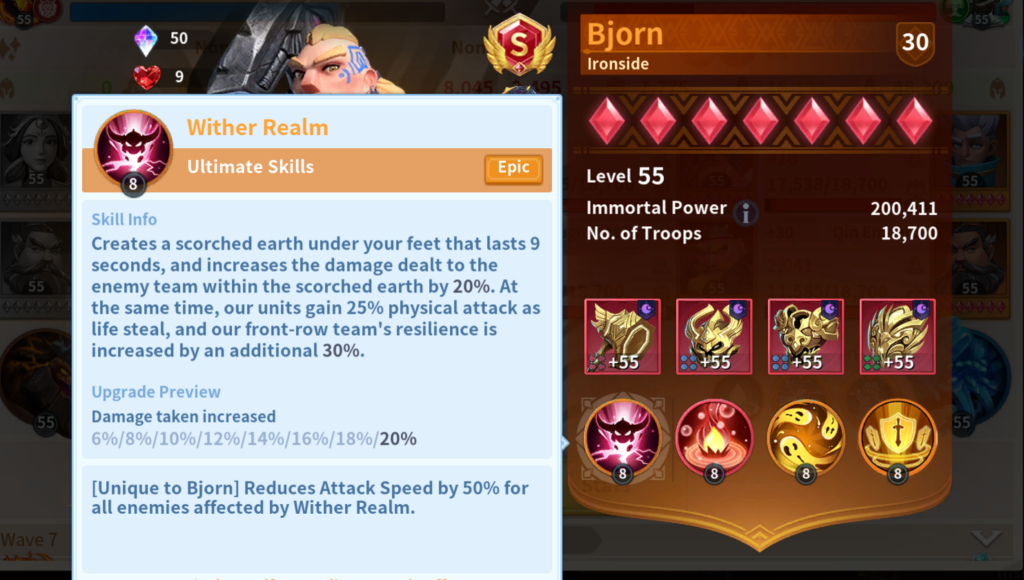
Bjorn's ultimate, Wither Realm, is one of the main reasons he fits this march so well. At level 8, Bjorn creates scorched earth beneath the formation for nine seconds. Enemies inside the area take increased damage, while your own units gain Life Steal and the frontline receives additional Resilience.
The offensive part is especially important for Merlin. Bjorn is not simply surviving; he is helping create a burst window by making the enemy more vulnerable. When their defensive stats are being reduced and Merlin is preparing another Prophecy, those effects become much more valuable than Bjorn dealing a little extra personal damage.
His exclusive artifact effect adds another layer by reducing the Attack Speed of enemies affected by Wither Realm by 50%. Against Alexander builds, that is huge. Alexander relies heavily on constant physical pressure, and slowing that pressure down makes the entire frontline feel much harder to break.
Weakening Curse
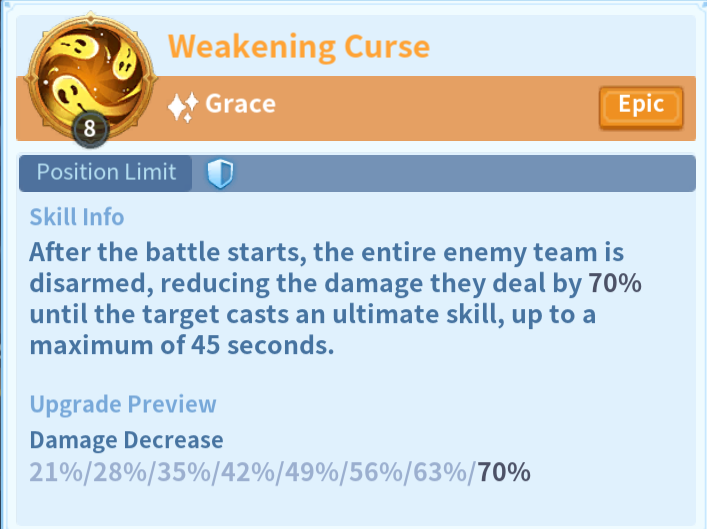
Weakening Curse gives the march a safer opening against aggressive compositions. At the start of battle, the enemy team is Disarmed and deals heavily reduced damage until each immortal casts its ultimate, with the effect lasting up to 45 seconds.
That opening protection matters because Water does not need to immediately overpower the opponent. It needs enough time for its defensive layers and Merlin's Energy cycle to establish themselves. Weakening Curse reduces the chance that a high-pressure march creates an early advantage before the rest of the setup starts functioning.
Energy Shield
Energy Shield is one of the main sustain tools in the build. Every six seconds, it has a chance to place a shield on three friendly immortals, absorbing a substantial amount of incoming damage for three seconds.
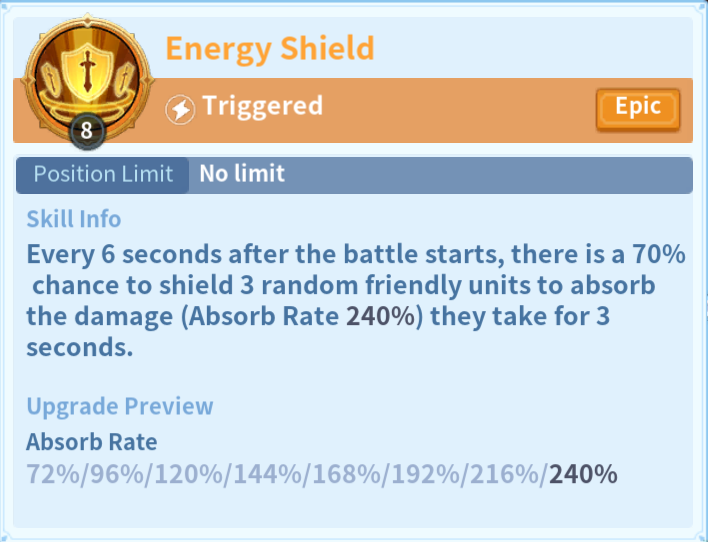
In the example battle, Energy Shield accounted for more than 8.6 million healing and shield value. That is a very large contribution, but I would think of it as part of the skill package rather than something Bjorn inherently does.
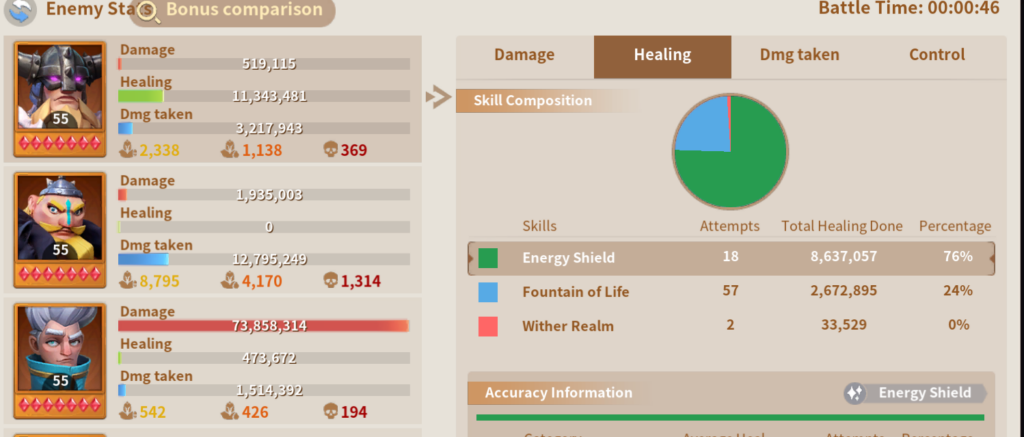
What matters is the timing. Those shields repeatedly create small windows where the frontline survives damage it otherwise would have taken directly. In a Merlin build, even a few extra seconds can be decisive because that may be all the time required for another Prophecy or Infinite Firepower activation.
Fountain of Life
Fountain of Life is mandatory in this setup because of the Silence immunity it provides at the beginning of battle. The six seconds of Silence immunity are extremely important because they stop the march from being exposed to No Escape during the opening.

That protection is one of the main reasons to use the skill. If Merlin or one of the key support immortals gets caught in early Silence pressure, the entire rotation of the march can become much less reliable. Fountain of Life gives you a much safer opening and prevents that weakness from being exploited.
The healing is still very good as well. In the example fight, Fountain of Life produced more than 2.6 million healing. That is a strong secondary benefit, especially in a march that wants the battle to last long enough for Merlin to keep cycling, but the Silence immunity is what makes the skill so important.
Ragnar Lothbrok — Physical Damage Suppression
Ragnar complements Bjorn by making the frontline even more unpleasant for physical attackers. His personal damage is not especially important here. His value comes from absorbing pressure, reducing the consistency of enemy physical damage, and creating windows where Merlin hits considerably harder.
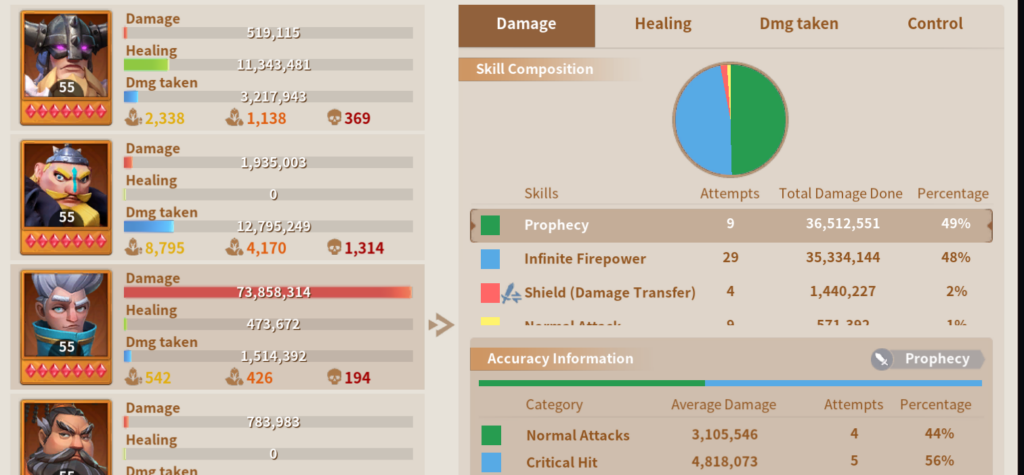
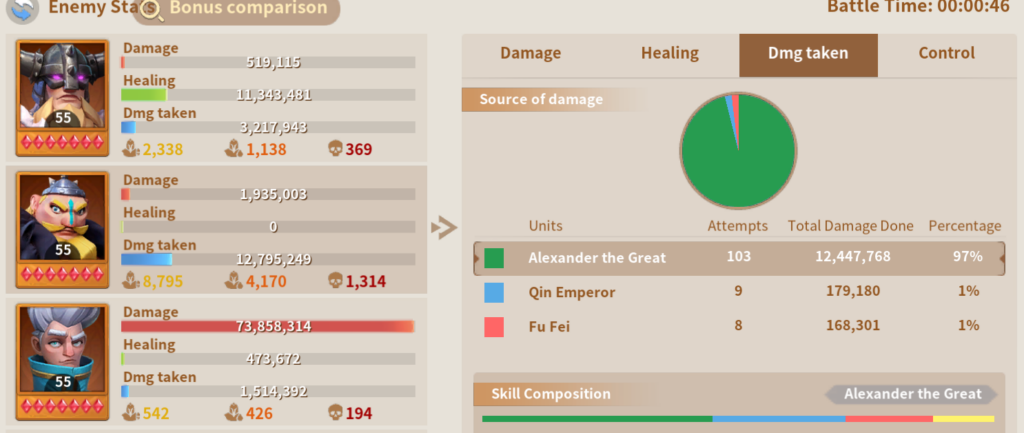
In the example battle, Ragnar absorbed around 12.8 million damage. That is exactly the type of contribution I want from him. Every hit Ragnar takes is a hit that is not reaching Merlin.
Frostbite Blow
Ragnar's ultimate, Frostbite Blow, deals physical damage to enemies in an area and causes them to take increased magical damage afterward. With his exclusive artifact effect, that magical-damage vulnerability lasts even longer.

This is where Ragnar becomes more than just a tank. His ultimate creates a direct damage window for Merlin. If Frostbite Blow lands shortly before Prophecy or a strong Infinite Firepower proc, Merlin is attacking targets that have already been made more vulnerable to magical damage.
That synergy is much more valuable than trying to build Ragnar as another damage dealer. He helps Merlin do the damage instead.
Malice
Malice reduces the Critical Rate of all enemy immortals from the beginning of the battle. It is a simple skill, but that simplicity is part of why it is useful.
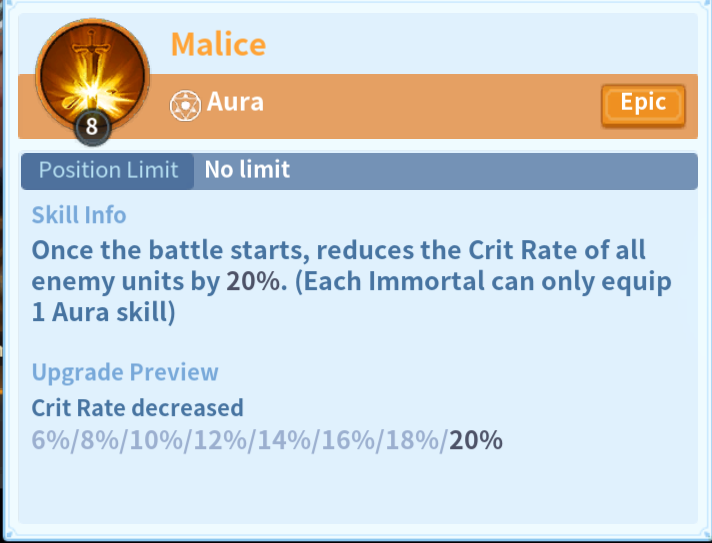
Against physical carries that rely heavily on critical hits, lowering their Crit Rate makes their pressure less consistent across the entire fight. The opponent still attacks the frontline, but the spikes become less dangerous and Bjorn and Ragnar are less likely to suddenly collapse to a chain of strong crits.
Toxin Barrier
Toxin Barrier punishes enemies for repeatedly attacking Ragnar. When he takes damage from normal attacks, he has a chance to apply Toxin to the attacker. Each stack reduces that target's physical damage, and the stacks eventually explode for additional damage.
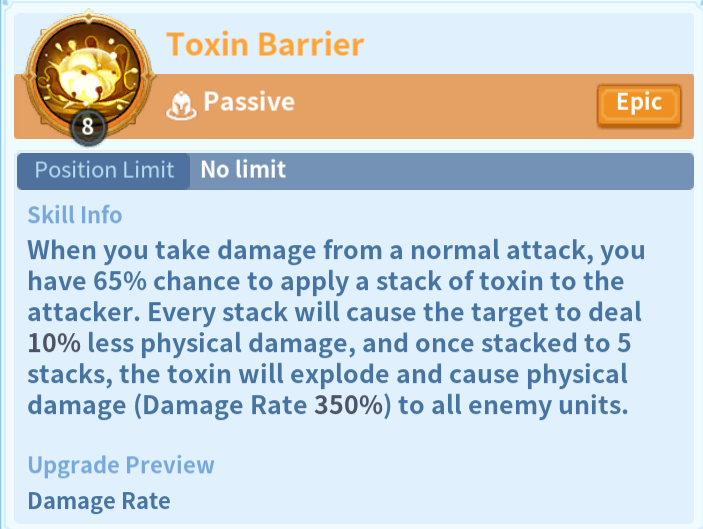
The physical-damage reduction is the main reason I like it here. Alexander wants to keep attacking. Ragnar gradually makes those attacks weaker. It fits perfectly with the rest of the march because the goal is not to stop Alexander from attacking entirely; it is to make those attacks less effective for long enough that Merlin wins the damage race.
Oaken Guard
Oaken Guard provides a very strong opening defensive window by reducing physical damage taken by three allied immortals for 18 seconds.

That duration is long enough to matter. When Oaken Guard is combined with Weakening Curse, Malice, Energy Shield and the natural durability of the frontline, the opponent has to work through several overlapping defensive layers before it can create meaningful pressure.
Against Alexander builds, this is one of the reasons the opening feels so much safer than you would expect from Water.
Fearless Stance
Ragnar uses Fearless Stance from the Iron Will talent tree. It increases his Resilience Rate and reduces the damage he takes after entering battle.
There is no need to complicate the choice. Ragnar's job is to stand in front of Merlin and absorb as much pressure as possible. Fearless Stance helps him do exactly that, which makes it a natural fit for the build.

Qin Emperor — Turning Merlin's Damage Into Permanent Damage
Qin is one of the most important pieces in the march. His job is to make Merlin's damage harder to recover from through applications of Wounds as well as to protect the backline, and add another layer of support around the march's main win condition.
The key part is that Qin changes how the sustain battle works. Without him, the opponent can often recover a meaningful part of Merlin's burst between casts, especially if they are running strong healing themselves. With Qin applying Wound, those healing windows become much less reliable, which means Merlin's damage starts to stick instead of being constantly repaired. That is what makes Qin such a natural fit for this regeneration setup: our side is trying to survive and recover, while the enemy is being denied the same luxury.
Dragon Power
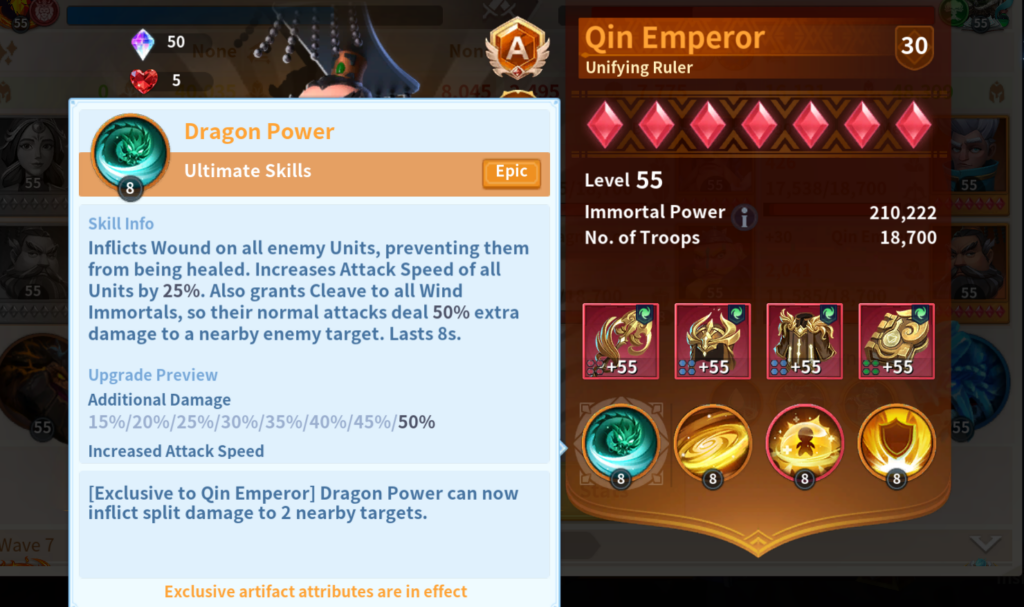
Qin's ultimate, Dragon Power, applies Wound to all enemy immortals, preventing them from being healed while the effect is active. The skill also has effects aimed at Wind immortals, but those are not the reason we bring Qin into this particular Water march. The important part is the anti-healing.
The combat report shows how much value that can create in a real fight. On the opposing Fu Fei, Fountain of Life recorded 15 successful healing attempts and 20 discarded attempts, while Elegant Dance recorded 7 successful attempts and 8 discarded attempts. In both cases, more than half of the attempted healing was lost.
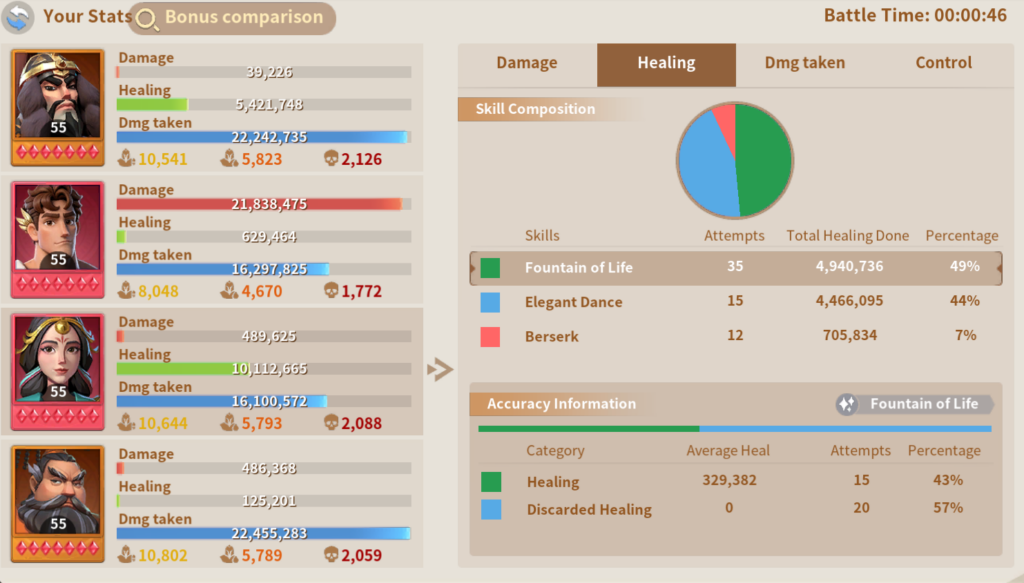
That matters enormously in a long fight. Merlin is dealing damage in large waves, and normally the opposing march would try to stabilize between those waves. Qin interrupts that process. The enemy may still have healing skills equipped, but a large portion of their recovery simply never happens, so every Prophecy and Infinite Firepower proc becomes harder to undo than the last one.
Heart of Arcana
Heart of Arcana increases the magical damage of all allied immortals by 35% from the start of battle, and in this setup most of that value is really there for Merlin. Qin does not need to become a serious damage dealer himself because Merlin already handles that role far more efficiently.
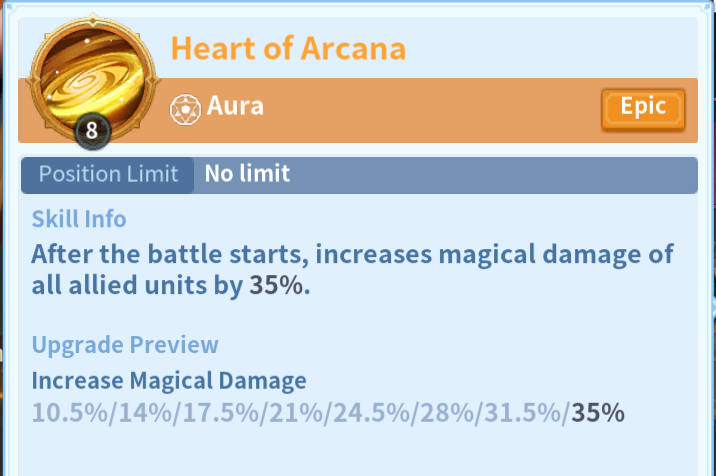
This is exactly the kind of support skill I want on Qin. Rather than trying to improve his own numbers, he contributes directly to the damage of the immortal the entire march is built around. When Merlin is already capable of producing huge Prophecy and Infinite Firepower hits, another large magical-damage modifier scales far better than trying to squeeze a little extra personal damage out of Qin.
Life Protection
Life Protection gives Qin a chance to increase his own self-healing while reducing the damage taken by the back row. It is a simple effect, but it fits the march very naturally because the back row is where Merlin is sitting.
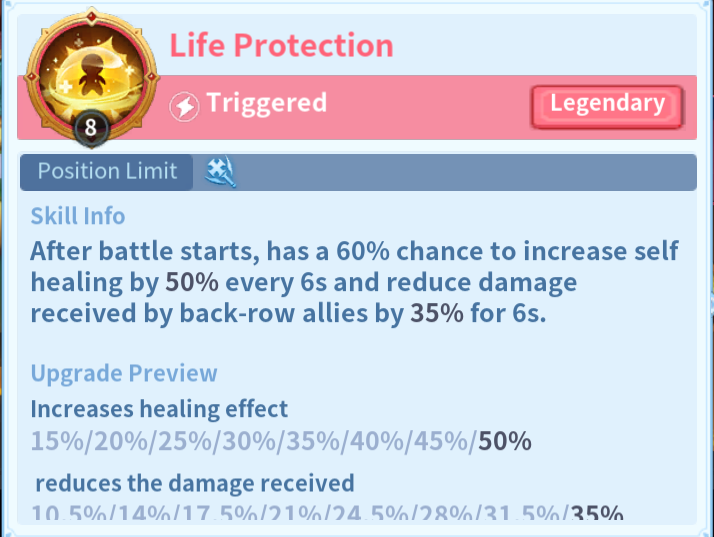
The frontline should already be absorbing most of the direct pressure, so when damage does begin to reach the backline, Life Protection helps make those moments less dangerous. Merlin does not need to be invincible; he just needs to survive long enough to keep cycling. Any skill that gives him a little more room to work has a lot of value in a build where his continued presence is the difference between winning and losing.
Assist
Assist takes that protective role even further. Every six seconds, it has a chance to select a random back-row ally and redirect the damage they would have taken onto Qin instead, while also reducing the transferred damage.
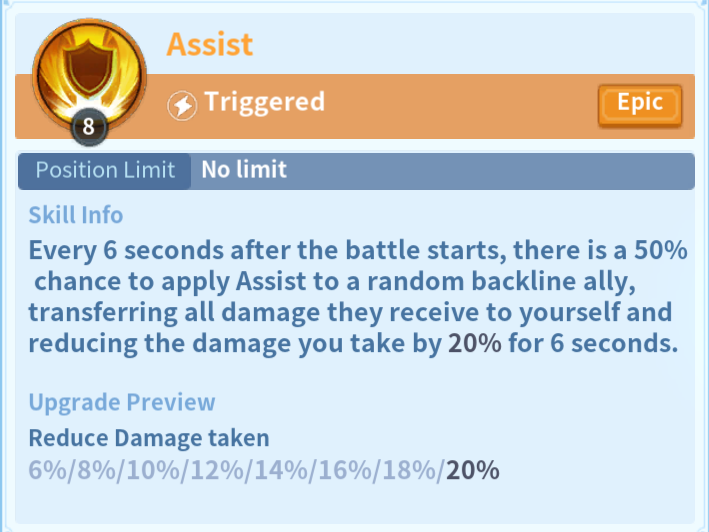
In practice, that gives Merlin another layer of protection behind Bjorn and Ragnar. Even if the opponent starts reaching the backline, Qin can absorb some of that pressure for him. It is one of those skills that may not look spectacular in a damage report, but it is very good at protecting the structure of the march. Merlin stays alive, keeps building Energy, and gets another chance to cast.
Battle Excitation
Qin uses Battle Excitation from Divine Blessing, which restores Energy to another back-row immortal at the beginning of battle and increases that immortal's damage. In this formation, that naturally means Merlin.

I like the talent because it supports exactly what we are already trying to do. Merlin gets moving faster, reaches his first important damage window earlier, and that early cast is stronger when it lands. The march itself is defensive, but that does not mean we want Merlin to start slowly. Battle Excitation helps the build establish offensive pressure while the frontline is still at its strongest.
Merlin — The Win Condition
Merlin is the reason the entire formation is worth building. Bjorn, Ragnar and Qin all contribute important mechanics, but none of them are supposed to compete with him for damage. Their purpose is to create a fight where Merlin can keep casting for long enough that his damage eventually becomes overwhelming.
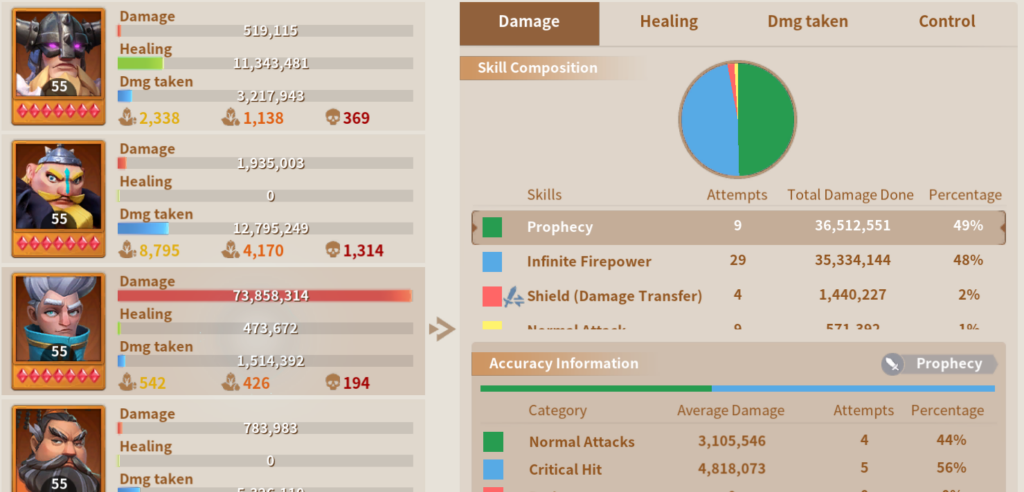
The example battle makes that very clear. Over 46 seconds, Merlin dealt 73,858,314 damage, which is far beyond the contribution of the other three immortals combined. That is not an imbalance in the build; it is exactly how the march is supposed to function. Merlin is the carry, while everyone around him is making sure the carry gets enough time to work.
What makes him particularly strong in this setup is that the march is not relying on a single Prophecy to decide the fight. Merlin is built to cycle repeatedly, with Infinite Firepower and Energy Mastery helping him move from one damage window into the next. The longer Bjorn and Ragnar keep the frontline intact, the more opportunities Merlin gets to take over the battle.
Prophecy
Merlin's ultimate, Prophecy, deals heavy magical damage to the entire enemy formation, with even more damage against Chilled targets. On its own, that already gives Merlin one of the strongest full-team burst tools available to Water, but the exclusive artifact effect makes it fit this build even better by restoring Energy and a small amount of HP whenever Prophecy deals damage.

The Energy recovery is the more important part for this setup because it keeps the next rotation moving. We are not trying to build around one perfect cast; we want Merlin to cast, recover a large portion of his Energy, and immediately start working toward the next one. In the example fight, Prophecy dealt more than 36.5 million damage across nine recorded damage events, so every additional cycle is a serious threat rather than a small bonus.
Infinite Firepower
Infinite Firepower is almost as important as Prophecy and is one of the main reasons the build can keep applying pressure between ultimate casts. Every few seconds it has a chance to deal heavy magical damage to the entire enemy team, while also increasing Merlin's Energy regeneration speed for a short period.
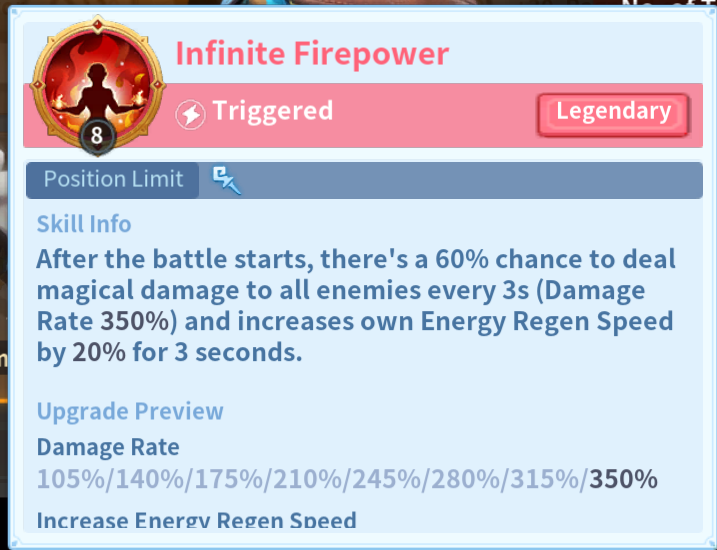
In the example battle, Infinite Firepower dealt more than 35.3 million damage, which was almost half of Merlin's total output. That is an enormous contribution from a Tower of Knowledge skill and shows why it belongs here. It does not just add damage between Prophecies; it also helps shorten the time until the next one, so both halves of the skill are working toward the same goal.
Energy Mastery
Energy Mastery is what makes Merlin's rotation feel much less like a one-and-done burst cycle. After he uses an Energy skill, he immediately restores 400 Energy and gains a large increase to Energy-skill damage for several seconds.
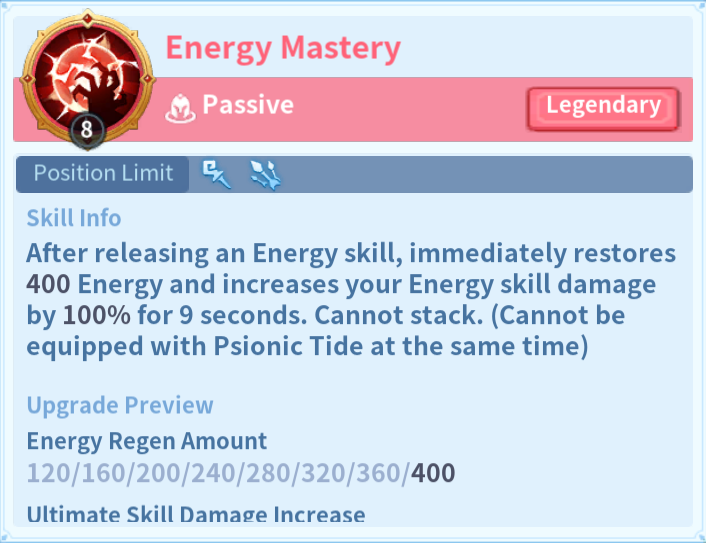
That immediate Energy return is extremely valuable because it keeps Merlin from falling back to zero after every cast. Combined with Infinite Firepower's Energy regeneration and the Energy restored by his artifact effect, he starts working toward the next Prophecy almost immediately. The march is buying him time, and Energy Mastery makes sure he uses that time efficiently.
Fighting Master
Fighting Master gives Merlin Control immunity and reduces the damage he takes. The defensive reduction is useful, but the Control immunity is a must have in order to avoid being controlled and interrupted. Merlin needs full uptime to shine and ramp up the damage.

A Merlin who gets controlled at the wrong moment can lose an entire damage window. That matters much more in this setup than simply missing a few seconds of attacks because his whole Energy cycle can be delayed. Ragnar may have already created a magical-damage vulnerability window, Qin may already have Wound active, and if Merlin cannot cast into it, a lot of the march's synergy is wasted. Fighting Master makes those rotations far more dependable.
Stormeye Spell
Merlin uses Stormeye Spell from Soul Burst, which gives him additional Critical Rate and Magical Damage after entering battle. It is an aggressive talent, but that is exactly what Merlin should be using here.

The rest of the march is already spending a huge amount of resources protecting him. Bjorn and Ragnar are tanking, Qin is redirecting damage and helping the back row survive, and the skill setup is built around giving Merlin time. His own talent choice should therefore be used to maximize the payoff once he gets that time. Stormeye Spell does that directly by making his major magical hits both more frequent and more dangerous.
Merlin's Artifact
For Merlin's artifact, I would specifically look for Dragon's Prophecy with Annihilation, ideally alongside strong Critical Rate rolls. The artifact shown in the build has 28% Critical Rate, another 4.2% Critical Rate, and a Magical Attack Bonus roll, which means Merlin is getting 32.2% Critical Rate from the artifact's Crit lines alone. Annihilation then adds another 25% Critical Damage.

That combination makes a lot of sense for the role Merlin is playing. The rest of the march is already responsible for survival, so his artifact should be about converting every damage window into as much pressure as possible. I would much rather have a strong offensive artifact on Merlin than try to make him slightly safer when three other immortals are already doing that job for him.
The battle report supports that approach. Out of nine recorded Prophecy damage events, five were critical hits, and those critical hits were considerably larger than the normal ones. When Stormeye Spell, high Critical Rate and Annihilation are all stacked together, Merlin becomes exactly what this march needs him to be: a protected carry with enough burst to punish any opponent that fails to break the frontline quickly.
Combat Example — Against Meta Alexander with Knife Through Butter
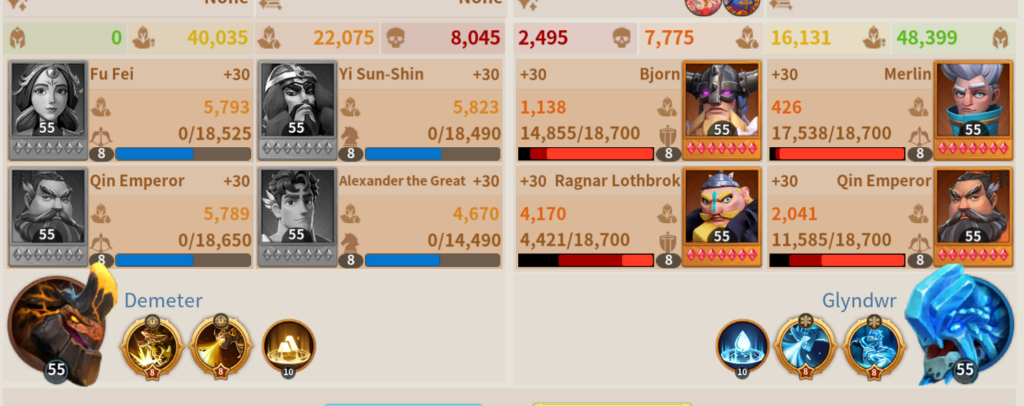
The battle against a meta Alexander setup running Knife Through Butter is a very good example of why this composition works. On paper, it is exactly the kind of matchup that should make Water uncomfortable. Alexander wants to apply heavy physical pressure immediately, cut through the frontline before Merlin has time to establish himself, and turn the fight into a collapse before Water can settle into its rotation.
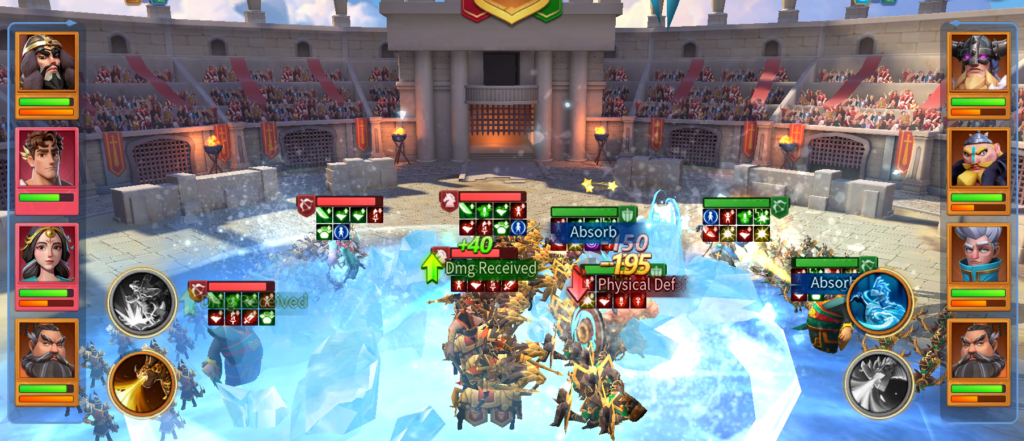
That does not happen here because Alexander first has to deal with Bjorn and Ragnar. Bjorn is reducing Attack Speed and making the enemy easier for Merlin to burst, while Ragnar is lowering the consistency and effectiveness of incoming physical damage. On top of that, Weakening Curse softens the opening, Oaken Guard reduces physical damage, Malice lowers enemy Critical Rate, and Energy Shield keeps creating small windows where the frontline absorbs pressure without losing meaningful troop count.
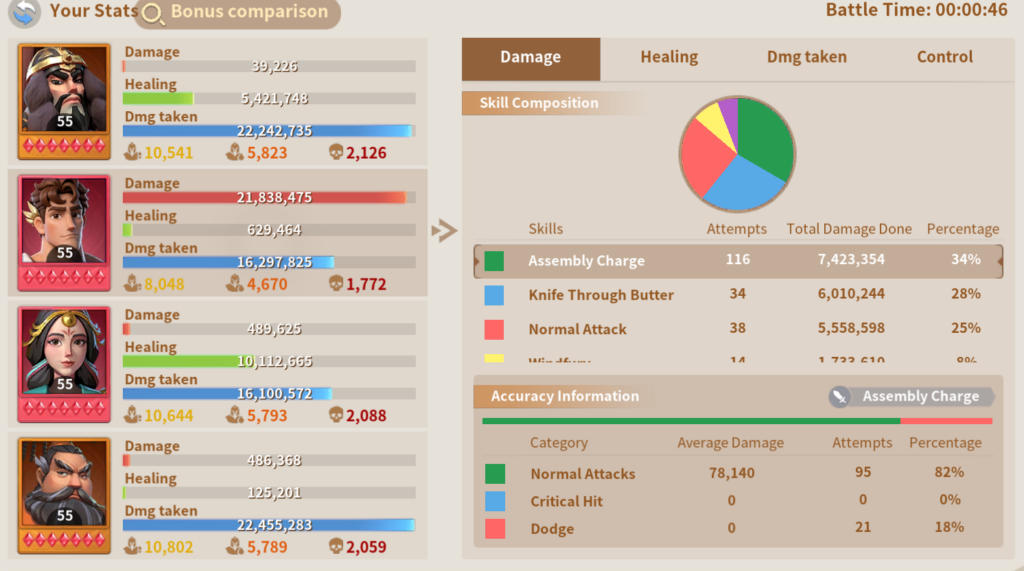
Alexander still does plenty of damage. He finishes the fight with more than 21.8 million, so this is not a case where the opposing carry is somehow neutralized completely. The important point is that his damage does not turn into kills quickly enough. He is hitting the wall, but the wall remains intact long enough for Merlin to keep operating behind it.
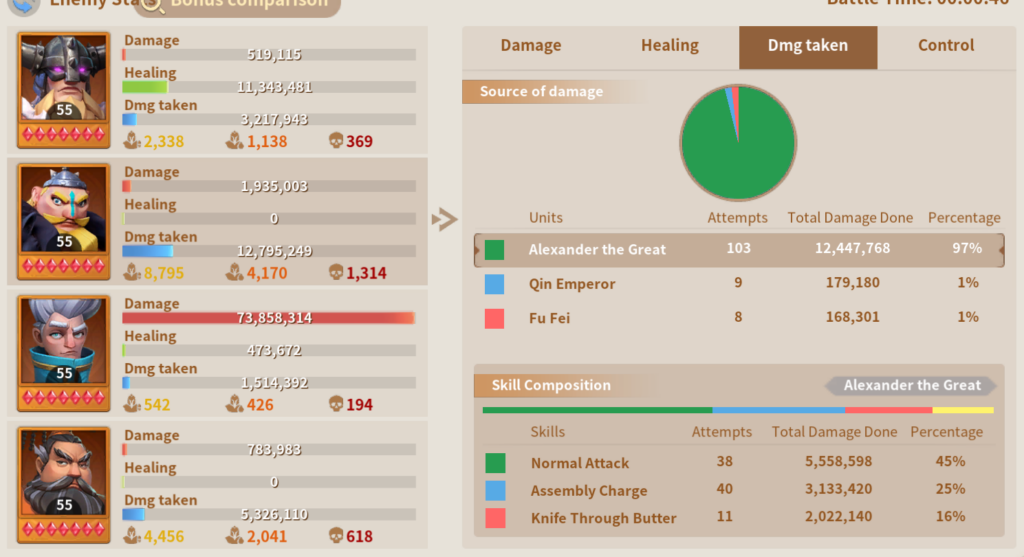
At the same time, Qin is making the opponent's recovery much less reliable. Fu Fei's Fountain of Life has 20 healing attempts discarded, while Elegant Dance loses another eight. That means the damage Merlin is putting into the enemy formation keeps carrying forward instead of being fully repaired between casts. The opponent is still trying to sustain, but Qin keeps removing a large part of that sustain from the fight.
Merlin then does what the whole march was built to let him do. He finishes with 73.86 million damage, including around 36.5 million from Prophecy and 35.3 million from Infinite Firepower. Those two sources account for almost all of his output, which shows how focused the build really is. The entire march is there to keep those two damage engines running.
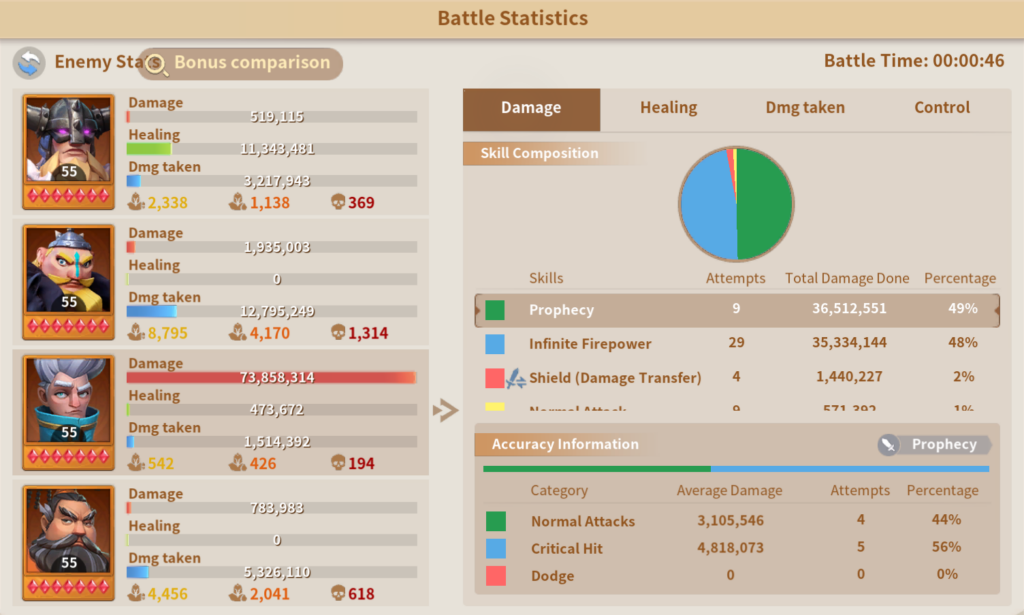
That is why I like this matchup as an example. Alexander is not weak, and the Water march is not winning because the opponent fails to apply pressure. It wins because Alexander cannot break through fast enough. Bjorn slows the pace of the fight, Ragnar makes the physical pressure less effective, Qin prevents the enemy from recovering, and Merlin is allowed to keep firing until the damage becomes impossible to manage.
Who This Build Is For
I would mainly recommend this build to players who have already committed significant resources to Water. If you developed Merlin early, kept farming Water Dragon Crystals, and now have a water dragon that is noticeably further ahead than your other dragons, there is a lot of value in continuing to build around that investment rather than abandoning it simply because the broader Conquest meta has moved toward Alexander.
That matters even more for mid spenders. A whale can pivot into a completely new march whenever the meta changes and catch up quickly through spending. Most players do not have that luxury, so the value of previous investment matters much more. If Water is already one of the strongest parts of your account, finding a Conquest setup that lets you keep using it can be far more efficient than starting another element from scratch.
The build also has room to continue developing into Legendary because its core idea is not tied to a narrow gimmick. A durable frontline, anti-healing support and a heavily invested Merlin remain useful as progression continues. You are not building something that only works for one brief stage of the game; you are giving an existing Water account a direction that can keep growing with it.
Why I Like the Build
What I like most about this setup is how cleanly every immortal fits into the same plan. Bjorn is there to be a brick wall while disrupting the enemy's ability to pressure that wall efficiently. Ragnar reduces physical pressure and creates magical-damage windows. Qin turns Merlin's burst into damage the enemy cannot comfortably heal away, while also protecting him from anything that reaches the backline. Merlin is left to concentrate almost entirely on killing the opposing formation.
That division of roles makes the march feel much more deliberate than simply stacking four strong immortals together. Every skill has a reason to be there, and most of those reasons eventually point back toward Merlin. Even the defensive choices are indirectly offensive because every extra second Bjorn or Ragnar survives is another second Merlin can spend building Energy and preparing another major cast.
I also think there is something genuinely appealing about playing a strong Water march in a stage of the game where most players have stopped expecting one. Conquest tends to produce a lot of very similar formations, especially around Alexander, so a well-developed Merlin setup immediately feels different. You are using years of Water investment instead of pretending it no longer matters, and you are doing it with a march that can actually punish the standard meta builds rather than simply survive against them.
That is the part I find most interesting. Water and Merlin are underrated largely because relatively few players continue developing them seriously. If you already made that commitment, you can turn what most people see as an old investment into something they have to respect again.