
Home / Events / Seasonal Events / Goddess Festival (March)
Cost efficiency obtain holy/shadow immortals: Goddesses event versus Theias
2026-03-20
When you move beyond the free rewards in seasonal events, the real comparison becomes straightforward: what does each fragment actually cost if you’re actively spending?
Introduction
When you move beyond the free rewards in seasonal events, the real comparison becomes straightforward: what does each fragment actually cost if you’re actively spending?
Theia’s Roulette gives a fixed and familiar path, while seasonal events require converting Tokens → Grails → Fragments. That extra layer makes it less intuitive, so it’s worth breaking it down step by step the same way most experienced players evaluate event efficiency.


Let’s take a closer look at what you’re actually paying when building Holy or Shadow immortals through these two systems. On the surface, both seasonal events and Theia’s Roulette offer reliable access to fragments—but the way costs accumulate is very different.
To make a fair comparison, we’ll break both methods down into their real cost per fragment, using practical spending patterns rather than idealized assumptions. This gives a clearer picture of which path holds up better over time for players actively investing in progression.
Seasonal Events — Token to Fragment Conversion
This is the core mechanic behind seasonal value. You’re not buying fragments directly—you’re buying Tokens of Light and converting them through Grails. Read more about the seasonal event Goddesses Celebration Festival 2026 here. This guide goes over collecting Grails via the Token of Lights and Dazzling Wish event tab.
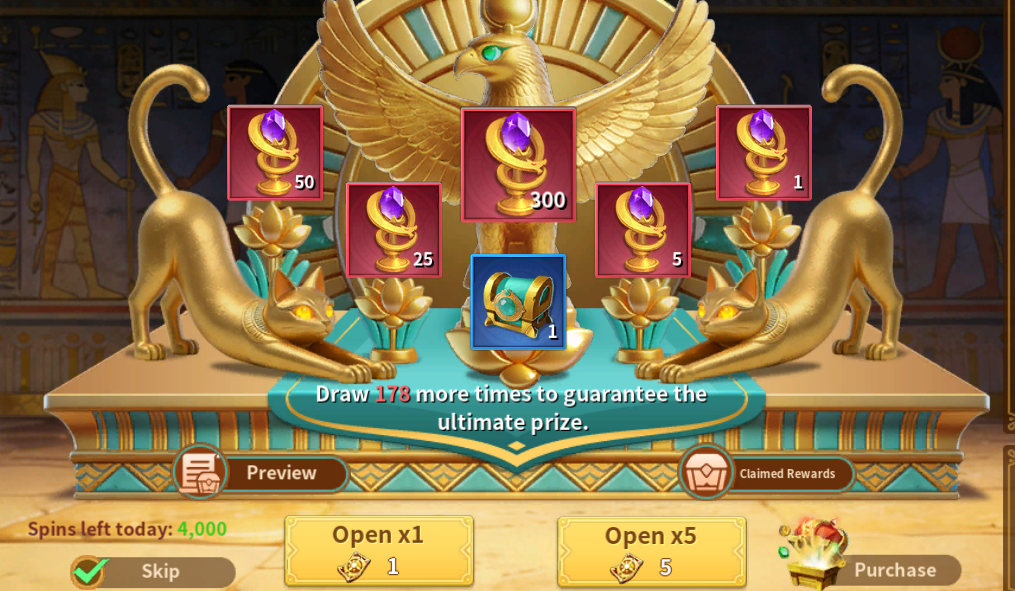
While these calculations are made using the recent seasonal event, it seems they are sticking to this event format and as such it is reasonable to assume future seasonal event will hold exact or very similar values.
Via the seasonal event shop:
- 160 Grails → 60 fragments → 1 fragment = 2.667 Grails
- 1 Token of Light = 4.325 Grails (average)
- Final conversion: → ~0.616 Tokens per fragment
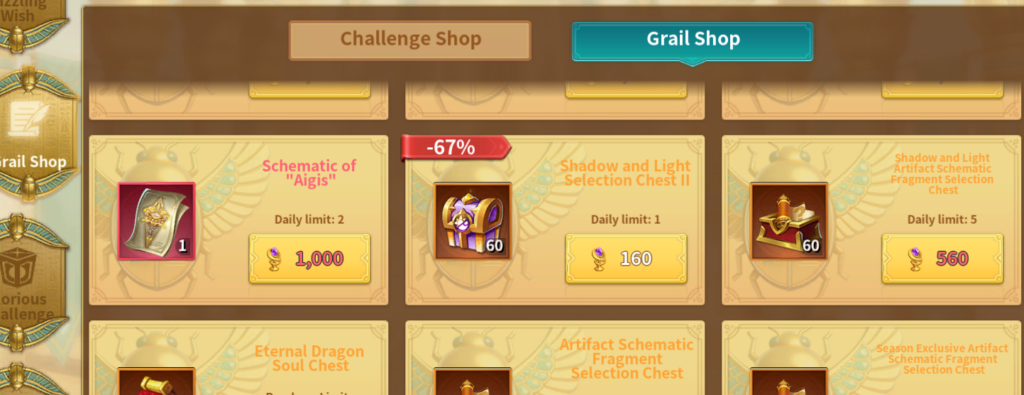
From a player perspective, this is the key ratio to remember. Once you know how much a token costs, you can immediately estimate your fragment price.
Token Pricing Scenarios
The real cost depends on how aggressively you buy bundles. In practice, most players fall into one of two patterns: either they stick to the most efficient bundles and stop once value drops off, or they push further during events and clear out all available packs despite the worse exchange rate.
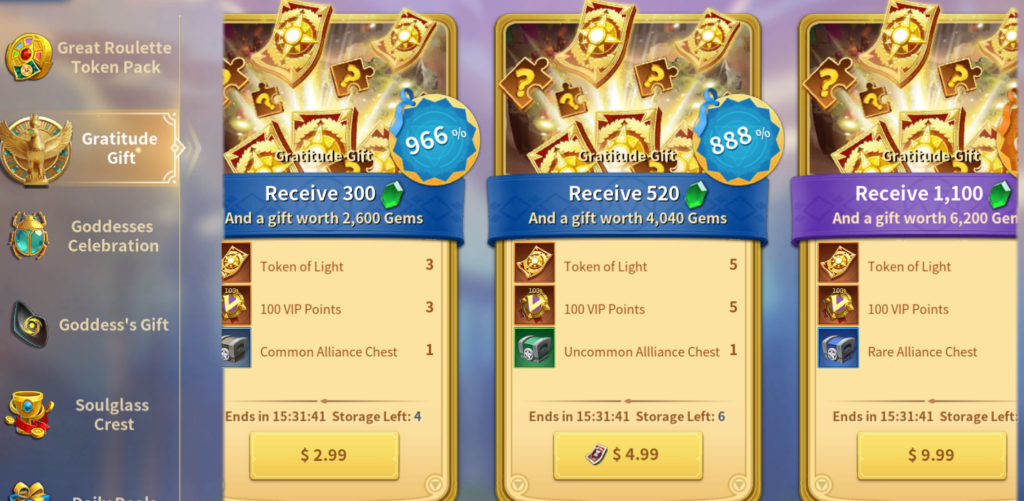
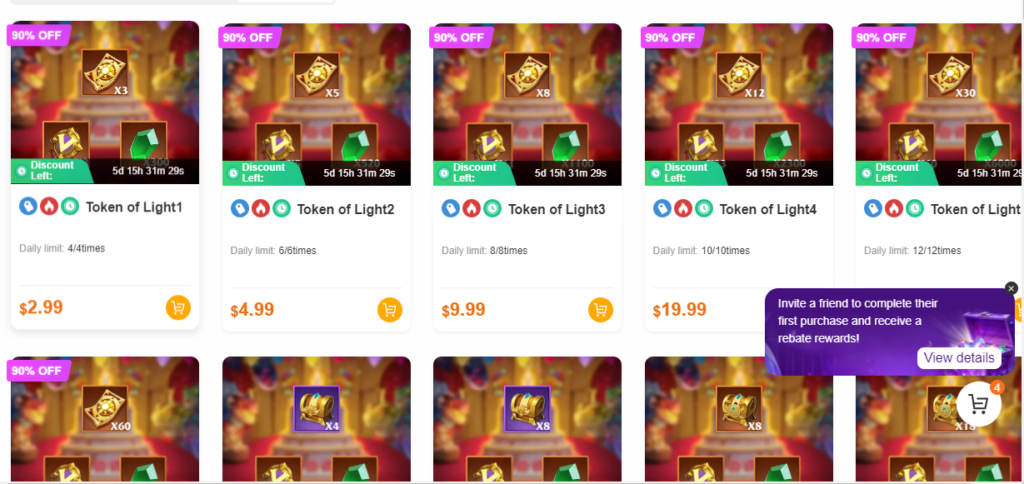
Efficient Spending (Best Bundles Only)
This assumes you only buy bundles where the exchange rate stays clean and consistent.
- $3 → 3 Tokens
- $5 → 5 Tokens
These maintain a $1 per Token ratio, which is the baseline for efficient spending.
Using our earlier conversion:
- 0.616 Tokens per fragment
- → 0.616 × $1 = $0.62 per fragment
This is the realistic floor. Players who manage their spending carefully and avoid inflated packs will stay close to this value.
Full Spend (Buying All Bundles)
This includes buying higher-tier bundles where the value drops off:
- $10 → 8 Tokens (~$1.25 per Token)
- $20 → 12 Tokens (~$1.67 per Token)
- $50 → 30 Tokens (~$1.67 per Token)
- $100 → 60 Tokens (~$1.67 per Token)
When averaged out across all bundles, this lands at roughly:
- ~$1.667 per Token
Applying the same conversion:
- 0.616 Tokens per fragment
- → 0.616 × $1.667 ≈ $1.03 per fragment
This reflects a more aggressive approach—typical during competitive seasons or when pushing an immortal quickly—where efficiency is traded for speed.
This distinction matters because it defines your real cost range in seasonal events. You’re not locked into a single price point—you’re choosing it through how far you go on the bundle ladder.
The real cost depends on how aggressively you buy bundles. Most players fall into one of these two patterns.
Efficient Spending (Best Bundles Only)
This assumes you stick to the most cost-efficient packs and ignore inflated ones.
- ~$1 per Token
- Cost per fragment: → 0.616 × $1 = $0.62 per fragment
In practice, this is what disciplined spenders aim for—buying out the best-value tiers daily and stopping there.
Full Spend (Buying All Bundles)
This reflects players pushing harder during events and clearing all available bundles.
- ~$1.667 per Token
- Cost per fragment: → 0.616 × $1.667 ≈ $1.03 per fragment
This is a more realistic upper bound for active spenders. Even here, the system remains relatively efficient.
Theia’s Roulette — Baseline Cost
Roulette is much simpler: you’re directly converting spins into fragments, so the pricing is more transparent. To read more about pricing of the Theia's event, see in-depth guide here.
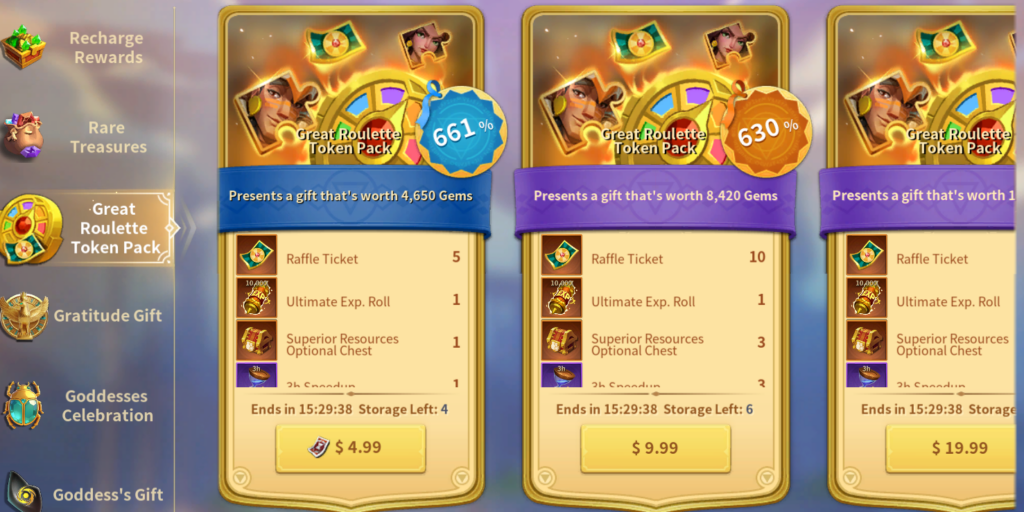
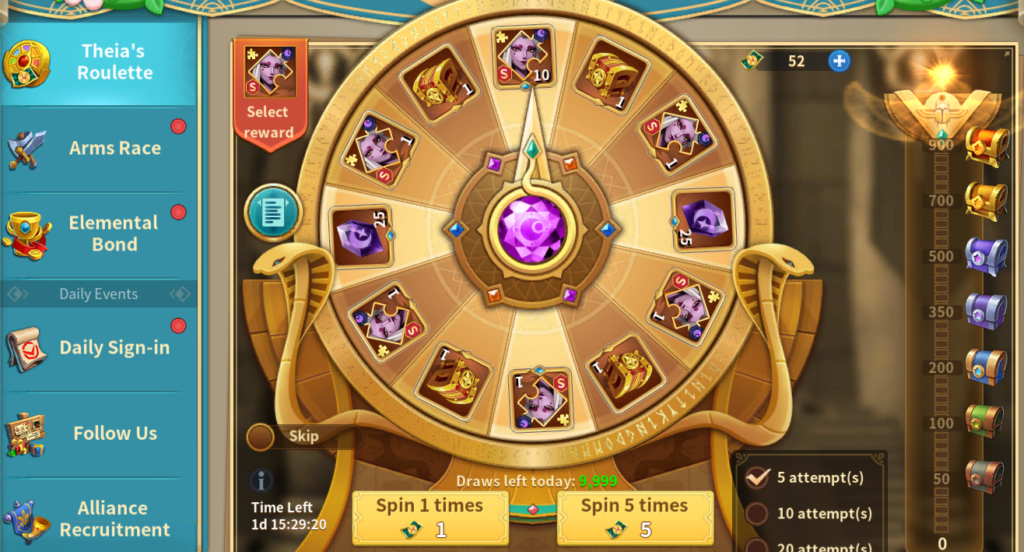
- Fast route (900 spins/week): → $1.52 per fragment
- Slow route (200 spins/week): → $1.46 per fragment → ~52 weeks to complete an immortal
Most players targeting Holy/Shadow seriously will lean toward the faster route, so $1.52 is the practical benchmark.
Direct Comparison
Putting both systems side by side:
- Seasonal (efficient bundles): $0.62 per fragment
- Seasonal (all bundles): $1.03 per fragment
- Theia (fast route): $1.52 per fragment
- Theia (slow route): $1.46 per fragment
Even without factoring in free Tokens from battle pass or shops, seasonal events come out ahead. What this means in practice is that we’re comparing both systems purely on paid input, ignoring all the extra value players naturally accumulate during a season.
In reality, seasonal events quietly include several additional sources of Tokens of Light:
- Free battle pass track
- Paid battle pass efficiency tiers
- Event shop exchanges
These don’t show up in a strict cost calculation, but they directly reduce the number of Tokens you actually need to buy. As a result, your effective cost per fragment in seasonal events is often lower than the $0.62–$1.03 range we calculated.
By contrast, Theia’s Roulette has very limited passive value. Outside of minor event rewards, most of your fragments come directly from spins you pay for. That means its calculated cost per fragment is much closer to what you actually experience in-game.
So when you compare the two systems strictly on paper, seasonal events are already cheaper. Once you include the natural flow of free Tokens during a season, the gap widens further in practice.
Player Perspective
Having run both approaches across multiple seasons, the difference shows up clearly over time.
- Seasonal events scale better with spending → Every Token consistently converts at a strong rate
- Theia’s Roulette is steady but capped in efficiency → You’re locked into its spin-to-fragment ratio
- Seasonal also has hidden value layers → Free Tokens (battle pass, shop) quietly reduce real costs further
In practice, Roulette feels smoother week-to-week, especially for slower progression. But once you start spending consistently, seasonal events overtake it in efficiency without much ambiguity.
Conclusion Summary
- Seasonal conversion: $0.62–$1.03 per fragment
- Theia’s Roulette: $1.46–$1.52 per fragment
Bottom line: If you’re spending with the goal of building Holy/Shadow immortals efficiently, seasonal events provide significantly better value. Theia’s Roulette remains a steady option, but it doesn’t compete on cost once you commit resources.