
Home / Legion of Frostborne (SvS) / Strategies and mechanics
Vision Guide: How Fog of War, Scouting and Blind Spots Work
2026-09-05
Vision is one of the most important and least explained mechanics in Legion of Frostborne, commonly referred to as KvK. When players first enter the Frozen Realm, most of the map is hidden beneath darkness. Unlike…
Vision is one of the most important and least explained mechanics in Legion of Frostborne, commonly referred to as KvK. When players first enter the Frozen Realm, most of the map is hidden beneath darkness. Unlike Norheim, where castles and troop movements are normally visible, the KvK map only reveals enemy activity when one of your sources of Vision reaches it.
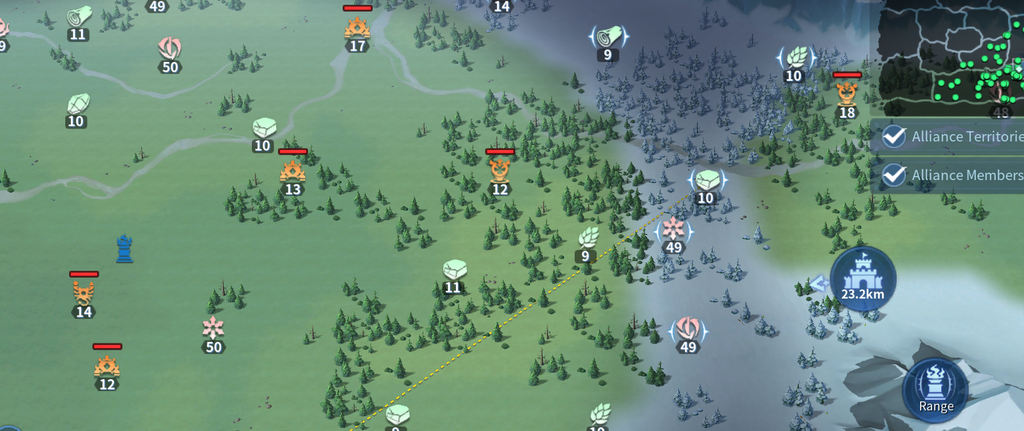
This is easy to mistake for a visual effect that simply makes the battlefield feel more mysterious. In reality, Vision determines far more than what appears on your screen. It affects whether you can locate and attack enemy castles, inspect objectives, continue a Thermal Tower chain and, in some situations, whether your alliance can attack a city or gate at all. Understanding it properly makes it easier to scout enemies, hide vulnerable castles and recognize why destroying a single Thermal Tower can disrupt an entire defensive position.
Weather adds another layer. Fog and Sunny conditions change the effective range of Thermal Towers, meaning the same tower network can provide different coverage from one day or province to the next. A route that looks safely illuminated today may contain blind spots tomorrow, while a favorable Sunny forecast can create an opportunity to extend a tower chain farther than normal.
Table of Contents
- What Vision reveals
- Sources of Vision and their ranges
- Shared alliance and Federation Vision
- Understanding the eye symbol
- How weather changes Vision
- Scouting hidden enemies with marches
- Using alternate castles as lamps
- Thermal Towers and objective warfare
- Denying Vision by dismantling towers
- Hiding in an enemy blind spot
- Common Vision mistakes
- Summary
What Does Vision Actually Reveal?
The darkness covering the Frozen Realm conceals enemy territories, troops, troop movements and relocation sites. Resource deposits, Gnome camps, cities and gates may still appear vaguely through the darkness, but you cannot inspect their complete information until you have Vision over the relevant area.
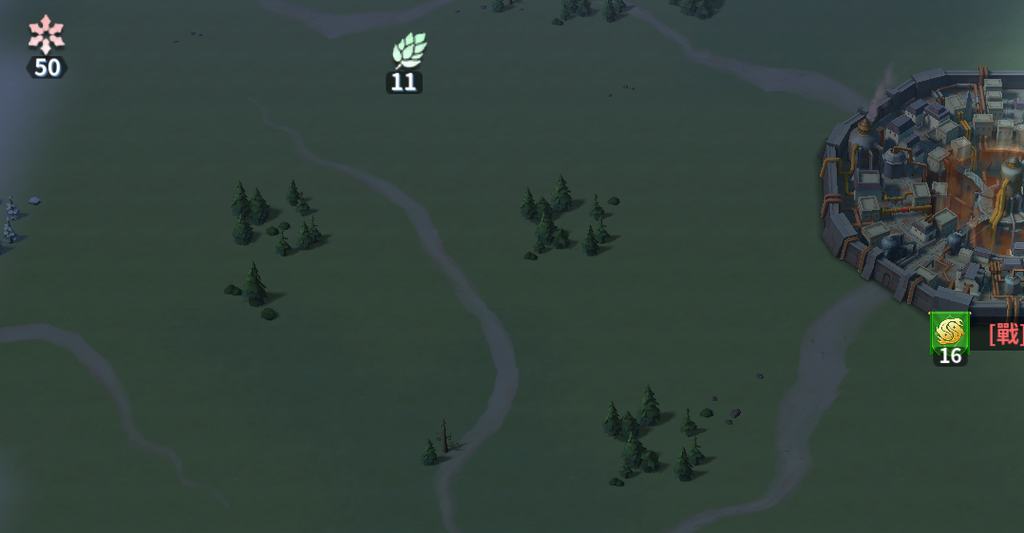
Once an enemy enters your Vision, the game reveals the target and allows you to interact with it normally. This can expose a castle that appeared to be sitting in empty space, show marches moving toward a gate or reveal the details of an objective your alliance is preparing to attack. If the source providing Vision moves away or disappears, the area returns to darkness unless another friendly source continues to cover it.
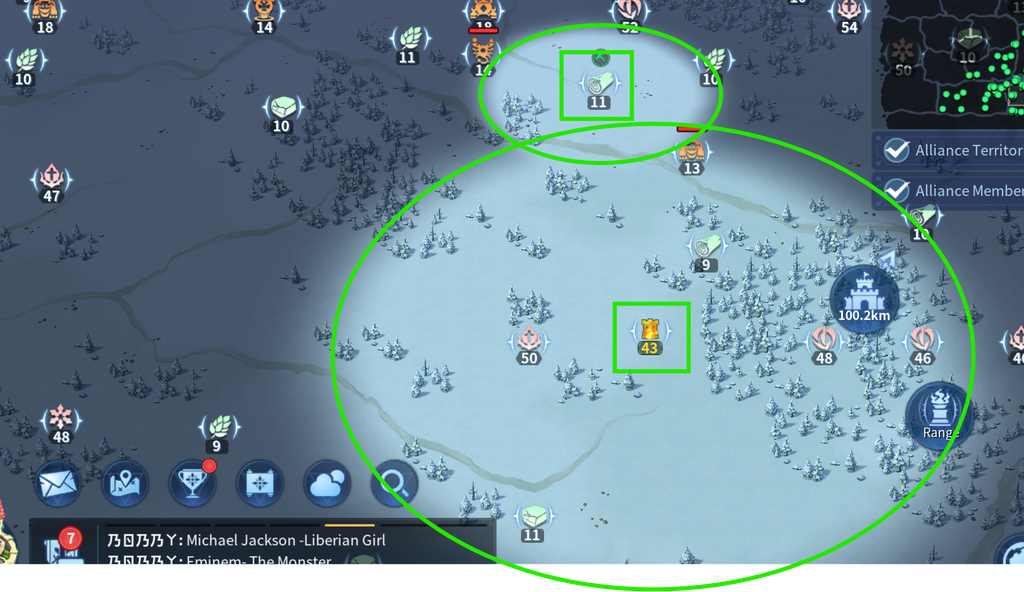
This makes Vision temporary and local. Your alliance does not gradually uncover the entire battlefield permanently. Instead, every castle, march, objective and Thermal Tower contributes its own area of visibility, and the map you can see at any moment is the combination of all those overlapping areas.
Sources of Vision and Their Ranges
The easiest way to understand the system is to treat every friendly object as a light source with its own radius.
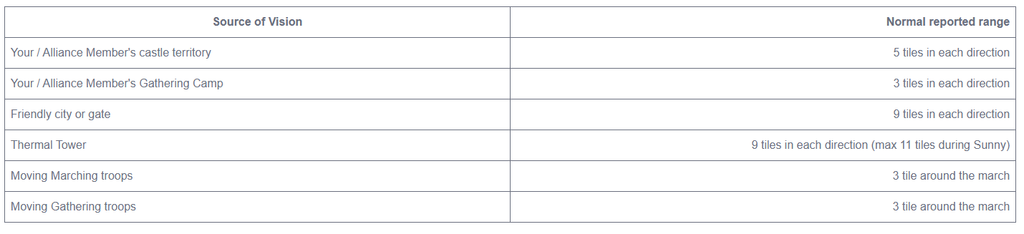
The tile values above are the ranges observed in current play and demonstrated in community testing. The official game description confirms the different sources of Vision but does not publish their numerical radii, so it is worth rechecking the edge of a tower's coverage after major KvK updates.
In practice, the distinction between the ranges matters. Castles provide a useful local bubble, but objectives and Thermal Towers illuminate a much larger area. Marches only reveal a narrow path, yet their mobility allows them to find targets that none of your permanent sources can currently see.
Shared Alliance and Federation Vision
Vision is shared between members of the same alliance. If an alliance member teleports into an otherwise dark area, their castle immediately becomes a new source of Vision for everyone else. The same applies to friendly cities, gates and Thermal Towers controlled by the alliance.
Friendly alliances can also share Vision through the relevant diplomatic relationship. In the modern Legion of Frostborne format, Federations connect several alliances from the same faction and allow them to cooperate across the battlefield. This makes Vision a coalition resource rather than something each alliance must always create by itself.
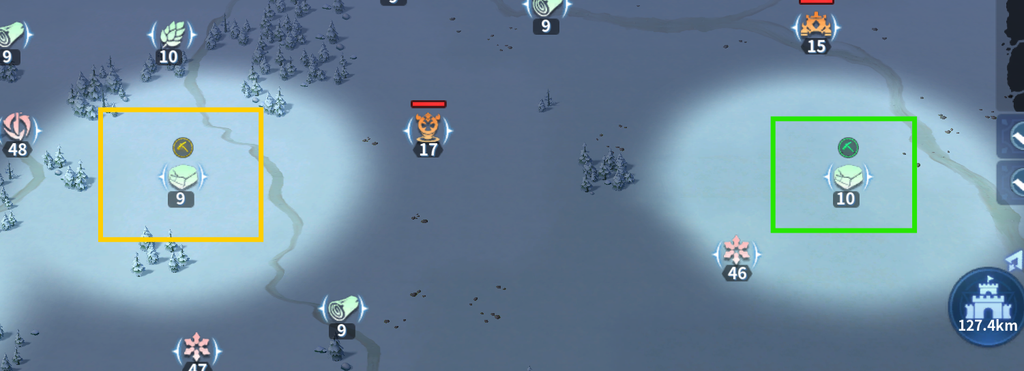
Shared Vision is one of the reasons diplomacy has such a practical effect in KvK. A smaller support alliance can illuminate an approach, maintain a tower route or position castles around an objective while the main fighting alliance concentrates its strongest players elsewhere. A castle does not need enough power to defeat an enemy in order to contribute. Sometimes its most valuable purpose is simply allowing everyone else to see.
The opposite is also true. When a diplomatic relationship ends, an alliance may lose access to Vision it had been relying upon. A route that looked completely secure can suddenly contain large patches of darkness because the castles and towers illuminating it belonged to someone else. Alliance leadership should therefore know which parts of the map are supported by its own assets and which are visible only because of Federation partners.
Understanding the Eye Symbol
When an enemy has Vision over your castle, an eye symbol appears above it. The same warning can appear over allied castles and Thermal Towers. This is the game's way of telling you that the position is currently exposed and can be seen by the opposing side.
If the eye is absent, the territory is sitting in an enemy blind spot. That is useful information, particularly when placing vulnerable players, reinforcement castles or alternate accounts near an active front. A hidden castle is much less likely to attract casual attacks because the enemy cannot simply find it while browsing the map.
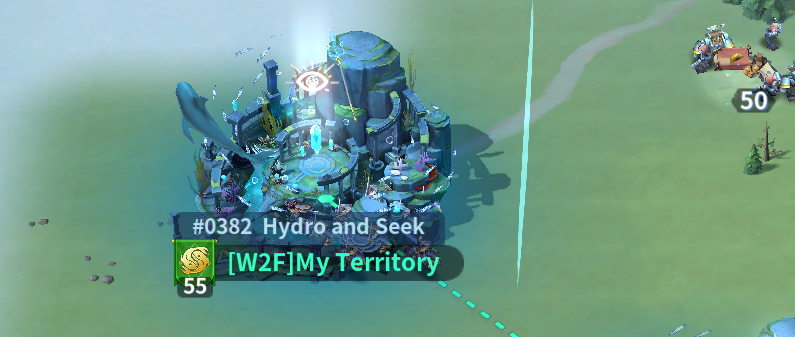
The missing eye should not be treated as a guarantee of safety. Enemy Vision can change at any moment. A scout may pass close enough to reveal the castle, a new Thermal Tower may finish construction, or a hostile castle may relocate nearby. Weather can also expand tower coverage into a previously hidden position. The eye is best understood as a live warning, not a permanent status.
This gives players a very simple defensive habit: whenever you relocate in KvK, check the castle for the eye symbol. If your intention was to hide in the darkness and the eye immediately appears, the position is not as concealed as it looked.
How Weather Changes Vision
Weather in Legion of Frostborne is regional. Every province can have different conditions, and the weather interface shows both the current state and the forecast for the following day. For Vision planning, the two important conditions are Fog and Sunny weather.

The weather rules specifically modify Thermal Tower range. They do not state that castle Vision, objective Vision or the one-tile bubble surrounding a march changes at the same time. This distinction matters because castles and moving troops can be used to compensate when Fog reduces the reach of your towers.
Fog can do more than increase the number of towers needed for expansion. If a castle or suspected enemy position is sitting near the outer edge of your normal tower range, a 25% reduction may return it to darkness. A planned attack route may lose visibility, a tower chain may become more awkward to extend, and an area around a choke point may become harder to monitor.
Sunny weather creates the opposite opportunity. The additional range can illuminate positions that were previously outside your coverage and allow an alliance to reach farther with fewer towers. Leadership teams planning a major expansion should therefore consult the forecast before committing their tower stock and construction tactics. If Sunny weather is approaching, waiting may save towers or make a difficult route much easier. If Fog is forecast, building a little redundancy into the route can prevent the entire operation from depending on a single reduced Vision bubble.
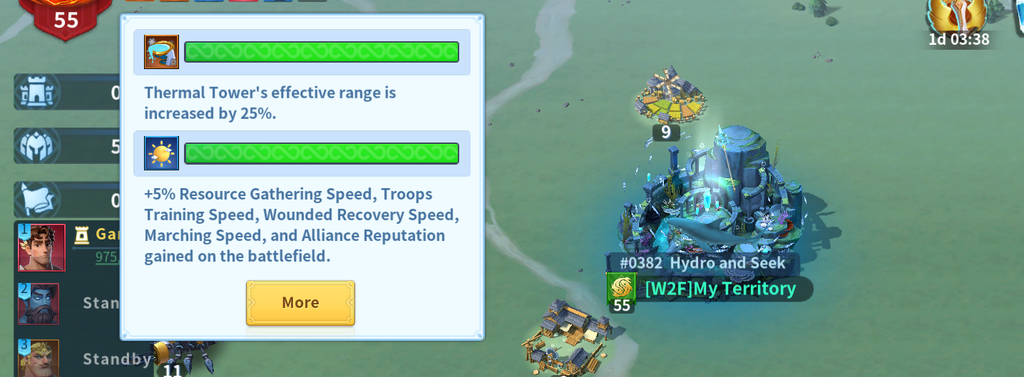
Weather can differ between neighboring provinces, so it is not enough to check the general conditions around your own castle. The relevant weather is the weather in the province through which the tower chain or military operation will actually pass. For the complete list of conditions and their gathering, combat and territory effects, see the Legion of Frostborne Weather System Guide.
Scouting Hidden Enemies With Marches
A moving march creates Vision three tiles around itself. This small radius does not look impressive beside a Thermal Tower, but it is one of the most flexible scouting tools available because it travels with the troops.
If you know the approximate location of an enemy castle, send a march toward a resource deposit or Gnome camp close to the suspected position. If there is no suitable target beside it, choose something farther away so the march route passes through the area you want to inspect. As the troops move, their Vision bubble travels along the path and briefly reveals enemy castles, marches or towers nearby.
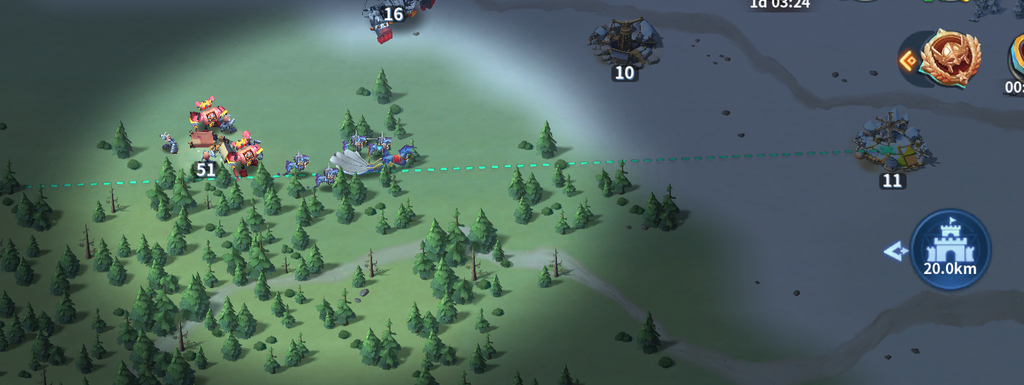
Route selection is the important part. Sending troops to the closest node may not help if the game chooses a path that misses the suspected castle by two tiles. A target behind the location is often better because it forces the march to cross the area rather than stopping short of it.
When the hidden territory appears, an attacker must be ready to act. The scouting march only provides Vision while it is close enough to the target, and the opportunity can disappear quickly as the troops continue along their route. For a coordinated hunt, one player can provide the moving Vision while another keeps a strong march ready to attack as soon as the castle is revealed.
Gathering can also be used to hold a small patch of Vision. If a resource deposit is located beside a suspected enemy position, leaving a march gathering there provides a three-tile observation point until the troops are recalled or removed. It is more persistent than a passing scout, although the gathering march is exposed and should not contain troops you cannot afford to lose.
Using Alternate Castles as Lamps
For longer-term scouting, alternate castles can be used as what many players call lamps. The idea is simple: place a shield on the alt, teleport it beside the area you want to monitor and use the castle's five-tile Vision range to illuminate the surroundings for the rest of the alliance or Federation.
A lamp can reveal hidden enemy castles, objectives and troop movements without requiring a main account to remain in a dangerous position. Because the castle continues providing Vision while shielded, it can be difficult for the opposing side to remove immediately. This makes lamps particularly useful around gates, contested cities, vulnerable tower chains and likely enemy relocation areas.
The alt must belong to an alliance whose Vision is shared with the players expected to use the information. Simply teleporting an unrelated account into the area will only help that account. Before placing a lamp, check the alliance, Federation and diplomatic setup so the Vision reaches the intended fighting alliance.
It is also worth considering what happens when the shield expires. A lamp placed deep inside hostile territory becomes an easy target once it is no longer protected, and losing the castle removes the Vision at exactly the moment the enemy may be preparing to move. Long operations therefore require either a sufficiently long shield or someone assigned to renew and monitor the account.
Used properly, lamps allow low-power accounts to make a meaningful battlefield contribution. They are not there to win fights. Their job is to remove the enemy's ability to hide and give the main alliance the information needed to choose its attacks.
Thermal Towers and Objective Warfare
Thermal Towers are the backbone of permanent Vision in Legion of Frostborne. They illuminate a broad area, protect territory from the Frozen Realm's environmental effects and create the network through which an alliance expands.
Vision is directly connected to tower placement. The first Thermal Tower must be placed within existing friendly Vision, commonly supplied by a nearby allied castle. Further towers are then placed within the range of the existing tower network. This is why a single forward castle or lamp can be strategically valuable: it can establish the initial visibility required to begin a new route.
The tower network also affects objective warfare. Cities and gates must be covered by an owned or allied Thermal Tower before an alliance can attack them. It is not enough to know where the objective is located. The alliance needs the required tower coverage to interact with it properly.
This makes a tower an operational asset rather than just an area buff. A defensive tower near a gate may be providing Vision of incoming troops, enabling further tower placement and preserving access to the objective at the same time. Losing it can therefore interrupt several parts of the defense simultaneously.
Vision and geothermal protection should not be confused. They are related because Thermal Towers provide both, but the rules governing overlap are not identical. Vision Proximity can overlap freely, while geothermal zones belonging to different alliances are subject to placement and priority restrictions. When examining the map, it is therefore possible for an area to be visible without receiving the same protection from the Frozen Realm's environmental effects.
Denying Vision by Dismantling Towers
One of the most important offensive uses of Vision is removing the enemy's sources rather than merely adding more of your own. According to the current Thermal Tower rules, a tower being dismantled stops providing Vision to its owner. Friendly towers also cannot be chained from that tower while the dismantling is underway.
This means an attack on a Thermal Tower can have an immediate effect even before its Durability reaches zero. The defenders may lose visibility over nearby castles and troop movements, while their planned expansion route is temporarily interrupted. If the targeted tower was the only source covering a gate, city or narrow approach, the entire area can become much harder to coordinate.
The demolition force naturally creates some local Vision through its own marches and its interaction with the target. Community testing also describes attackers as gaining the tower's Vision while dismantling it. The exact size and duration of this attacking Vision should be rechecked after major KvK updates, but the confirmed defensive consequence is already significant: the tower's owner loses the wide Vision bubble until the demolition troops are expelled.
This explains why alliances should respond quickly when a critical tower begins flashing under attack. Allowing even a small demolition force to remain inside is not harmless simply because the tower will take time to fall. The attackers may already have blinded the surrounding position and disabled its value as a link in the tower chain.
From the attacking side, tower dismantling should be coordinated with whatever comes next. If the goal is to conceal a larger march, expose hidden castles or disrupt reinforcements around a gate, those movements should begin while the defenders are missing their tower Vision. Destroying a tower and then waiting several hours to use the opening wastes much of the tactical value.
Hiding in an Enemy Blind Spot
Players usually think about Vision offensively, but the system is equally useful for concealment. A castle positioned just beyond the edge of enemy Vision cannot be seen through ordinary map browsing. This is useful for weaker accounts, rally participants, reserve fighters and alts supporting an operation.
The safest blind spots are not simply places without a nearby enemy tower. You must account for enemy castles, captured objectives, Federation partners and moving troops as well. An area that looks dark from one enemy alliance's perspective may be completely visible to another alliance sharing information with it.
Weather can change the calculation. Fog may pull the edge of enemy tower coverage away from your castle, while Sunny weather can suddenly place the same position inside their Vision. If a castle is relying on a very narrow gap for protection, checking the next day's forecast is just as important as checking the eye symbol when first relocating.
Movement also creates exposure. A hidden castle may be revealed when an enemy sends a march past it, even if the march is travelling toward an unrelated resource node. Experienced players sometimes use apparently ordinary gathering routes precisely because the path sweeps through likely blind spots. Remaining hidden therefore depends partly on avoiding predictable locations beside nodes and common travel lines.
Common Vision Mistakes
Most Vision mistakes come from treating the darkness as empty space rather than as an area containing information you do not currently possess.
- Assuming an empty map means there are no enemies: Castles and marches can be sitting directly in front of you without appearing until you create Vision.
- Ignoring the eye symbol: If the eye is visible, the enemy can see the position. A castle intended as a hidden staging point should be moved or protected accordingly.
- Confusing Vision with geothermal protection: Thermal Towers supply both, but visibility and protection do not follow identical overlap rules.
- Planning tower chains without checking weather: Fog can reduce tower range by 25%, while Sunny can make the same route considerably easier.
- Scouting without an attacker ready: A passing march may reveal a castle for only a brief window. The combat march should be prepared before the scout reaches it.
- Using an unprotected lamp: An exposed alt is easy to remove, and its Vision disappears with it.
- Forgetting shared Vision: An enemy Federation may see far more than the nearest hostile alliance's own towers and castles suggest.
- Treating tower demolition as a slow, harmless process: The defender can lose the tower's Vision as soon as dismantling begins, long before the tower is destroyed.
Conclusion
Vision is one of the mechanics that separates Legion of Frostborne from ordinary fighting in Norheim. Castles provide local visibility, captured objectives and Thermal Towers illuminate larger areas, and marches create small moving bubbles that can be used to search through the darkness. All of this information can be shared through alliance, diplomatic and Federation relationships.
The eye symbol shows when a castle or tower is currently exposed to enemy Vision. When it disappears, the position is in a blind spot, but that safety can change quickly when troops pass nearby, a new tower is constructed or Sunny weather extends an existing tower's range.
For ordinary players, the main lesson is to check whether the enemy can see you and to understand how a scouting march can reveal targets. For alliance leadership, Vision is part of the structure of the entire battlefield. It determines tower routes, objective access, forward positioning and the information available during an attack. Fog and Sunny weather change Thermal Tower coverage by 25%, while dismantling a critical tower can blind its owner and interrupt further expansion before the tower itself has fallen.
Once you begin looking at KvK through Vision rather than simply through power and march strength, many battlefield decisions make more sense. The alliance that controls what can be seen often controls where the next fight happens as well.
Related Guides and Sources
- Legion of Frostborne Weather System Guide
- Thermal Towers: Information and Strategies
- Strategic Positioning and Blocking
- Using Alts and Level 1 Alliances to Win